Logged into Pinterest the other day to share my latest post and to my surprise, I had an invitation. It was for a board of Garden Tips with 3700+ followers.
So I guess this means I’ve officially been recognized as someone that reliably plays in dirt on a routine basis and may have posts… or in this case, pins, to share about it. Kind of groovy, I thought. 🙂
Thanks again, to all of you who read this little, slowly growing blog and especially those that have given Dirt shout-outs or shared my posts.
I’d probably write it whether anyone read it or not, but a little encouragement never hurts!
-Belle
Month: March 2013

Where oh where has my little spring gone…

Spring FAIL
I posted this picture on Facebook this morning.
It seems that a certain groundhog had all that business about an EARLY spring WAY off the mark. It’s the end of March here and we just had another 4-6 inches of snow fall on us yesterday. I’ll admit- I’m brooding a bit. I’m usually out and busy in the yard by now; moving plants around, prepping planting beds, cleaning up fall’s debris. Spring seems to have missed that right turn at Albuquerque and maybe has become lost somewhere in west Texas. There were fabulous buds all over my magnolia trees, which I’m not sure will go ahead as planned now. Sigh…
Yes, I’m impatient and I want to get my hands in the dirt, but these late snows may not be such a bad thing. For instance, all those little trees I planted last year- suffered through one of the worst droughts the Midwest has seen in 30 years. A lot of crops failed and left fields bare and exposed to erosion. Drought, especially in soils like clay (which is what I have here) or in areas of high erosion, can leach a lot of nutrients, like nitrogen, from the soil. Plants use nitrogen by absorbing it through their roots and converting it to proteins; a plant in nitrogen deficient soil will often show yellowing of mature leaves. Drought conditions affect plant health and yields in large farms, which also changes the amount of nitrogen removed from the soil and the cover left on a field following harvest. On highly erodible land, farms must leave a certain amount of crop residue to conserve the nutrients in the soil. Tilling the soil can expose the nutrients and good bacteria underneath to the air, light and wind- causing these valuable nutrients to be stripped away. Cover crops and no-till practices can help preserve nutrients, but in a severe drought, it’s much harder for farms in high erosion areas to maintain soil health.
Snow is a great mulch and fertilizer.
I’ve heard several farmers mention this on the local news when asked about the early spring snows and wondered why, so of course I did what I do best… a little research. Snow provides a layer of insulation when temperatures are rapidly fluctuating between freeze and thaw; it keeps the soil temperature a bit more constant. Constantly expanding and contracting soil can be hard on little roots and bulbs close to the surface, which is why gardeners preach the benefits of a layer of mulch. A thick layer of snow acts much like several inches of mulch on the ground.

I’d kill for soil like this!!!
In the past several years, I’ve watched my plants bloom or put out leaf buds early, only to be murdered by one of those vicious, sneaky, late frosts. One year, my magnolias were in full bloom and froze hard. They were still young trees and I feared they had put forth so much energy to bloom that they would be exhausted and unable to recover from the frost. They struggled a bit, but made it through. Snow cover in the early parts of spring, when the danger of a frost is still likely but the days can be very warm, can be a real bud and bloom saver. This is why master gardeners preach mulch, mulch, MULCH! Snow is natural cover, just like mulch. It keeps the ground temperature down, so trees and flowers remain dormant longer and don’t start showing off too early in the season to avoid a killer frost.
Snow (and rain too), pick up nitrogen compounds from the air. Snow especially; since the water is absorbed more slowly into the earth, deposits nitrogen into the soil that is then utilized by plants in nitrogen fixation. Even if the soil is frozen, when it thaws, it will absorb the nitrogen. Nitrogen is what gives a lawn its deep, green color. Farmers have called snow the poor man’s fertilizer, since good snows over their fields improve soil conditions naturally. After this snow finally melts away, we may be rewarded with a spring of especially rich greens and prolific blooms. In the meantime I have my houseplants and tomato and pepper seedlings, which are in need of transplant this week. They’ll be graduating from those egg cartons to plastic drinking water bottles I’ve been saving. Fingers crossed- they’re predicting a warm up to the 60’s next week! Maybe after the yard dries a bit I’ll be able to relieve this cabin fever and start prepping those beds.
Right now, outside my window, it’s snowing. Again.
-B
Share this:

Victory Gardens and Daylight Savings
 I have spring fever and I’m procrastinating working on my books today- plus I’ve still got some “Spring Forward” lag. I’ve actually heard a rumor that Missouri is considering doing away with the observance of daylight savings time. I wondered why exactly did we begin observing DST? So, I did some reading. Turns out, I couldn’t find an absolutely definitive answer, but many references cited World War I and II. In order to reduce the use of fuel used for artificial lighting, people began turning the clocks back in fall.
I read that half of Indiana observes DST and half the state doesn’t. Yeesh, how annoying would that be if you lived on the dividing line?
What interested me amidst the DST debate was the mention of Victory Gardens. Apparently, in World War II, citizens were encouraged to grow vegetable, fruit and herb gardens to reduce pressure on the public food supply. People dug up their yards and even spaces in public parks to contribute to the production of food in the US, United Kingdom and Canada. Victory gardens could be found in backyards, on rooftops in the cities; many vacant lots were borrowed to use as cornfields. Lawn areas in Hyde Park, London; around Riverside in New York City and Golden Gate in San Francisco were all plowed and planted to publicize the victory garden movement.
During World War II, many farmers were drafted into the military and especially in Europe; farms were destroyed as the war moved through those areas. In 1917, the U.S. formed the National War Garden Commission overseeing the Victory Gardens campaign. Over five million gardens were planted, producing more than $1.2 billion in homegrown food by the end of the war. 20 million Americans tended Victory Gardens; they accounted for almost half the produce being consumed in the U.S. during World War II.
Even Eleanor Roosevelt participated in the effort, planting a Victory Garden on the White House grounds. Posters and public service booklets proclaimed “Our food is fighting!” All that produce helped lower the price of vegetables needed by the U.S. War Department; the money saved could be spent in other areas of the military.
One of the reasons for implementing daylight savings time was supposedly to aid in the tending of the Victory Gardens. With many of the men at war and women stepping in to temporarily fill jobs left behind, many women were at work during daylight hours. Extending the amount of evening daylight available, gave them an extra hour after work to tend their gardens.
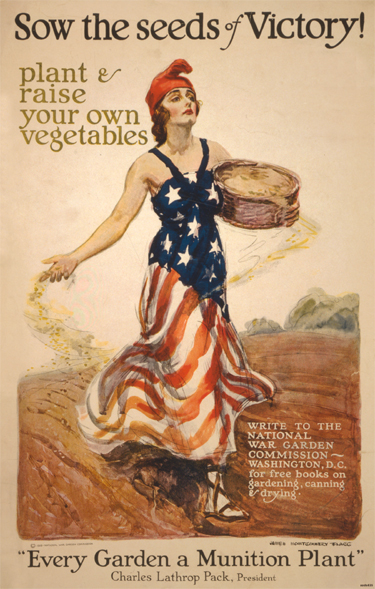 There are a few examples of Victory Gardens left in in the United States; Fenway Victory Gardens in Boston, Massachusetts (now mostly planted with flowers) and Dowling Community Garden in Minneapolis (Still veggies!) have remained active since WWII.
In recent years, the idea of the Victory Garden has resurfaced somewhat; a few have been replanted in public spaces, a websites and blogs such as http://www.modernvictorygarden.com/ promote their own Victory Gardens and encourage others to join in planting their own. In March of 2009, a garden was again planted on the White House Lawn, the first since Eleanor Roosevelt’s, to raise healthy food awareness. Many health conscious families are starting gardens for the first time, in an attempt to cut back on the hormones, pesticides and chemicals present in processed and even fresh commercial fruits and vegetables.
Now there’s one more great reason to garden… I’m doing my patriotic duty! 😉
(As if I EVER need an excuse to play in dirt.)
-B
Share this:

Ghetto Greenhouse
 I learned a few things last year when I started peppers and tomato plants from seed, so I decided this year to improve on my experience. I started my plantings this year with an actual seed starting formula instead of just generic potting soil. Even though, I almost always buy Miracle Gro, this particular blend is supposed to help with good root development- which if you read my previous article, this is one of THE most important aspects of successful tomato plants: excellent root growth. It was a few more $ than the regular potting mix, but one small bag was more than enough for starting all my seedlings.
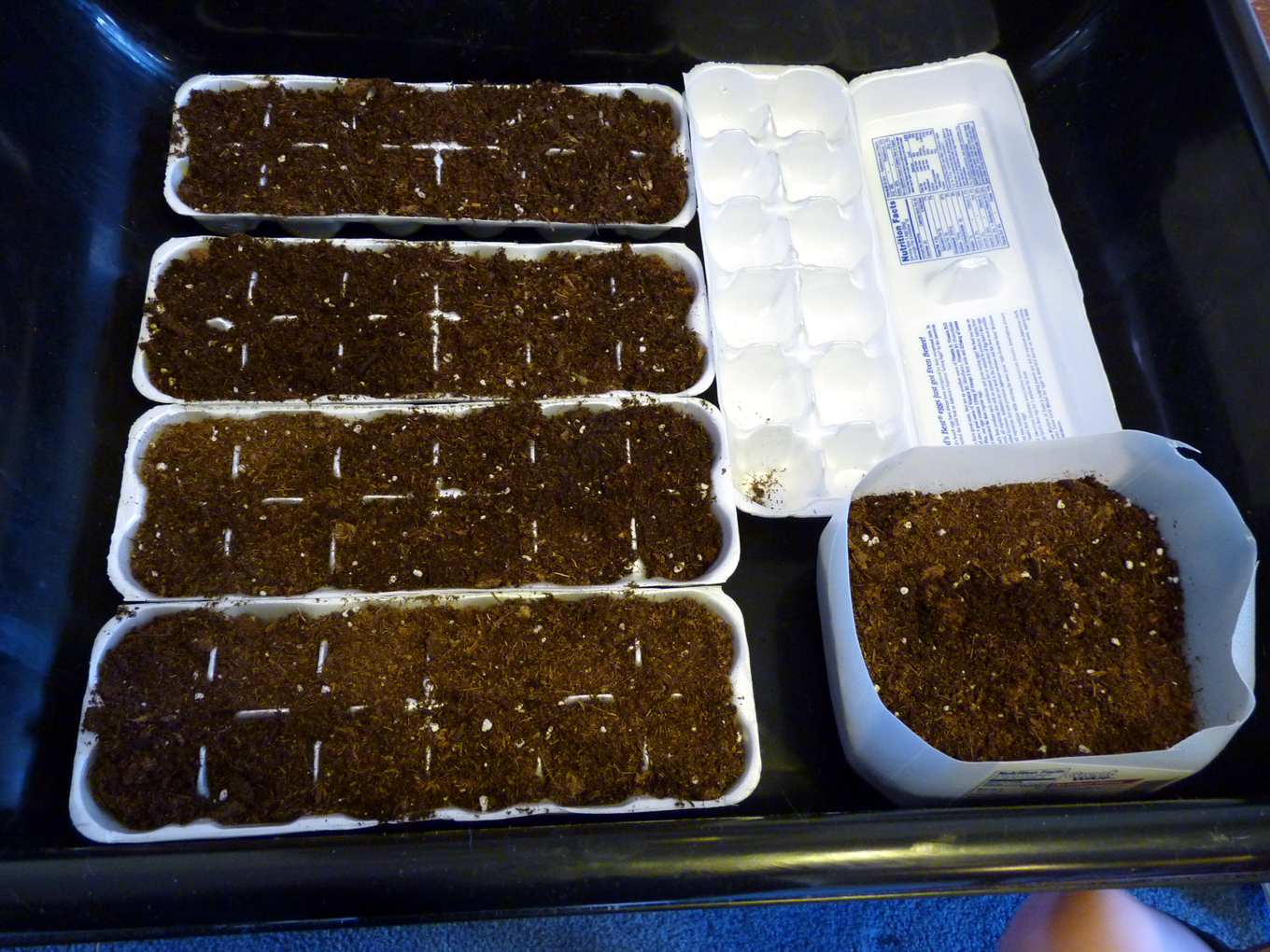 Last year, I started seeds in gallon milk jugs that I’d cut the tops from. I dumped all the seeds in together into the jug and set the top back on the bottom half to make mini-greenhouses. This seemed a great idea at the time, I found out that when the seedlings outgrew their milk jug homes and needed to be moved to individual containers, it was very difficult if not impossible to separate their roots without destroying some of them. This year, I opted for saving egg cartons. I tried to keep it to no more than 1 or 2 seeds per cell. I did run out of cartons and had to put a few in a lid and a few more in a halved milk jug. I tried to keep them further apart than I had the previous year though. If the individual cells work well, I’ll be sure to use all egg cartons with cells next year.
The egg cartons are sitting in a big, black plastic garden tub I picked up at Lowes for only $8. I figured it would be much nicer to move about than several different trays- I used cookie sheets to hold all my bottles and containers last year, which worked ok, but it was kind of a pain in the butt moving multiple sheets in and out when it came time to harden off the seedlings. This tub contains everything nicely, it’s waterproof, easy clean up and it’s black, so it will help absorb heat.
 We were having trouble getting those tiny little tomato and pepper seeds to stay put where we wanted them, so my daughter helped me make seed tapes. Some very tiny seeds will come from the seed companies already in paper tapes. Seed starting kits from the store often come with miniature pots made of peat and a thin, biodegradable net to keep them from falling apart until the roots create a network to hold the pete in place when removed. I cut small squares of paper towel, and sprayed them with a couple squirts from a spray bottle while she held it in her hand. We then set the seed on the wet towel, which stuck very nicely. I was able to move a bit of soil from and egg cell, put the paper down with the seed and have it stay in place while covering it back up with soil. The paper towel degrades naturally and doesn’t stop the roots from growing, just like the net-wrapped pete cells. The pete cells are convenient, but can be costly for a large set up. This method only costs you about 1 paper towel per 20 or so seeds. 🙂
 Once all our seeds were planted I used a tea spoon to lightly firm the soil over the seeds. You don’t need to really pack them down, you want the soil to stay a bit light for those tiny, tender little roots to take hold. Watering will help to further settle the soil around the seeds and help them to start germination. A fancy tool isn’t necessary for planting seeds, this old teaspoon and fingers worked well.
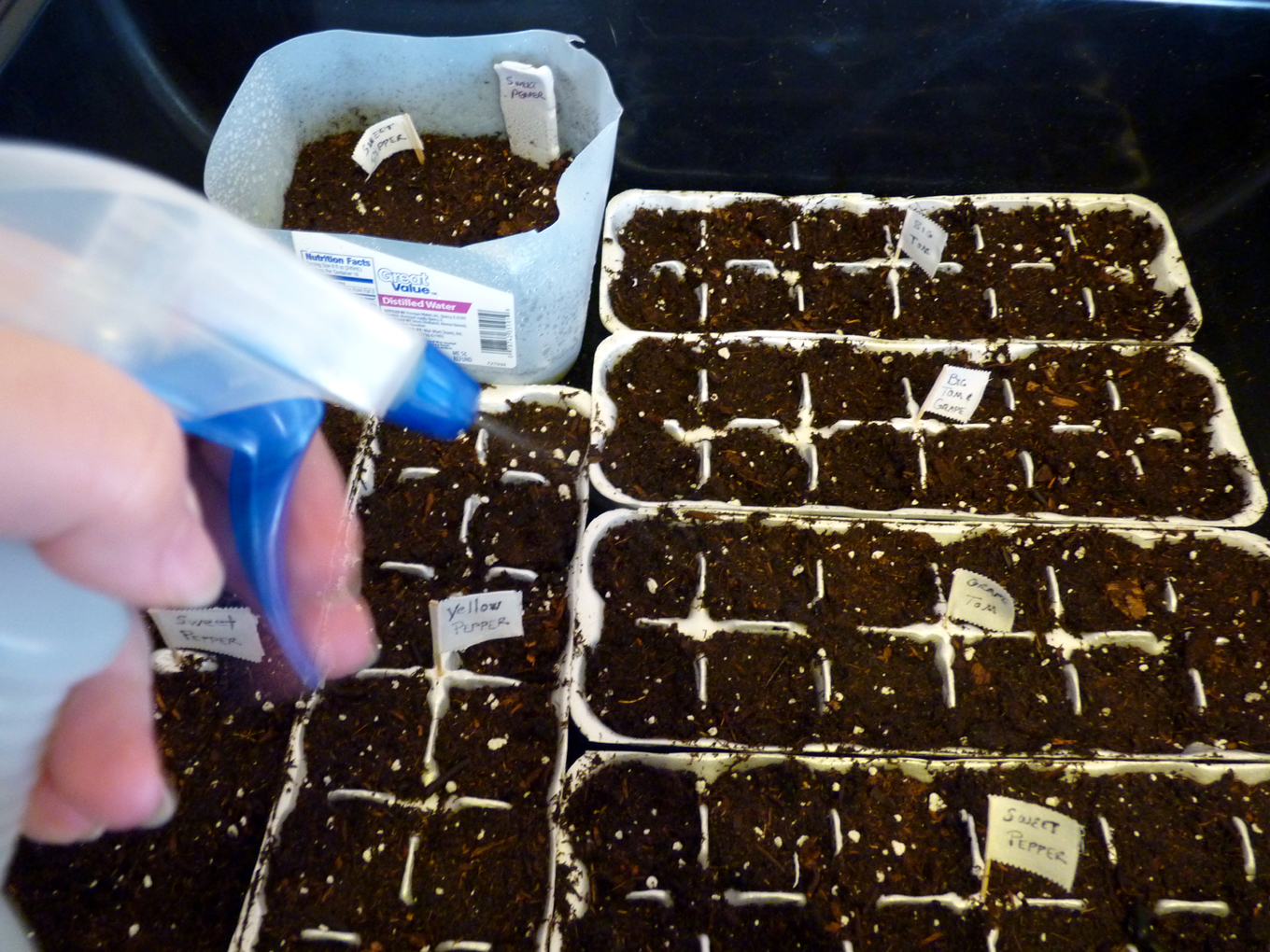 After all the seeds are covered in soil, you’ll need to give them a good drink. I’ve found that pouring water displaces too much soil when you’re dealing with small seeds and shallow cells. I use a spray bottle filled with water, the same one I keep for training cats, cleaning houseplant leaves, etc. It cost me $2 at the grocery store. I’ll continue using this to water while the seedling are in these tiny cells. Over watering could cause mildew to develop or rot the roots.
 Tomato seedlings are pretty distinctive and it isn’t difficult to differentiate between tomato and pepper plants once they get a few leaves on them. However, I planted two different types of tomatoes and two different types of peppers. If it’s important to you that you can tell what you’ve planted where later, make sure to label everything. Otherwise, you’ll be playing roulette with your seedlings when you put them out in the garden, since they won’t have identifiable fruit when they’re transplanted. I used toothpicks wrapped in cloth tape and wrote on them with a permanent laundry marker. I’ve seen people use old silverware, which looks elegant in the garden itself, Popsicle sticks, plastic cutlery- last year I cut triangles from my left over egg carton lids and wrote on those. It’s not important WHAT you use. Just make sure it’s A) Waterproof and B) Won’t degrade before your plants are ready to be moved outdoors.
 In case you forget when your plants are supposed to germinate, would like to remember the specific water, spacing or sun requirements or just want to know the plant name so you can choose the same for next year (or brag about the particular type of heirloom you planted and grew with great success)- you’ll want to keep your seed packets or write it down somewhere. If you order your seeds online and created an account with the seller, they’ll probably have your order on file and you can refer back to it that way. Personally, I find it easiest to just hang on to the seed packets themselves. I put them in a Zip-loc baggie to keep them from getting dirty or wet and tucked them into my plastic tray right next to the seedlings. Easy reference, close at hand. Stick them in a file to reorder next year after moving your plants to the garden.

I put my finished seed tray in front of our big bay window, which gets all but the late afternoon sun. It’s sitting on top of my daughter’s wagon, so it moves around nicely. That’s a leftover bit of drywall board underneath it for stability. I use what I have and re-purpose what I can. I see lots of fancy shelving systems with installed grow lights and such. Get them if you feel they make your life easier, your growing space look more attractive, or whatever the reason- but know that they are absolutely NOT necessary to successfully grow plants, regardless of what the salespeople or online ads tell you. The black plastic tub with help absorb and retain warmth on the seedlings, since I don’t use seed warming mats either. I put a bit of clear plastic over the tray that was leftover drop cloth from a painting project; it helps to retain warmth and moisture while the seeds germinate. They don’t really need a grow light until they actually break through the soil.
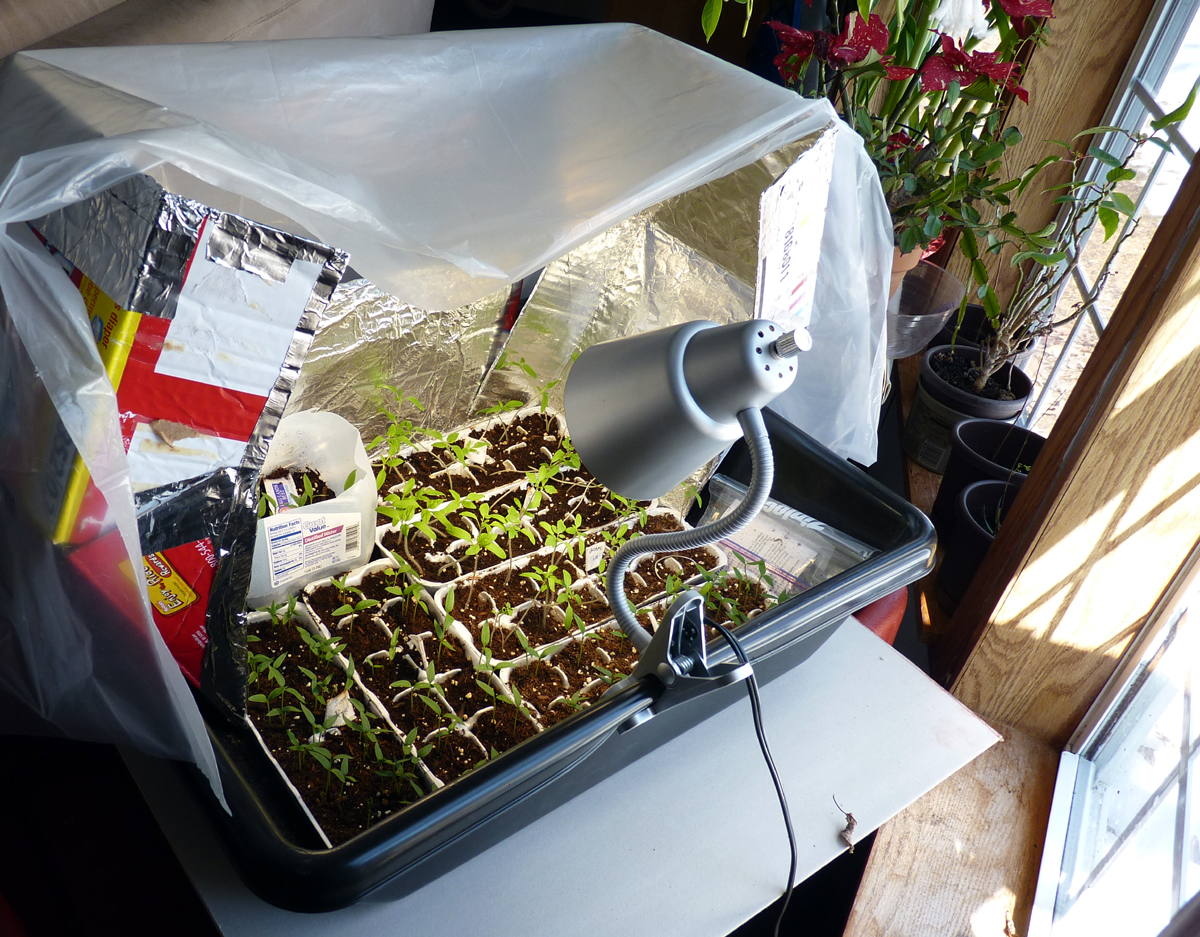 This photo I took today, it’s about 3 1/2 weeks from our initial plant date. You can see that I have some pretty decent sized seedlings already. The tomato plants all came up first, the peppers took about a week longer. I did notice after a week of good growth that the tomato plants were getting a bit leggy (long, thin stems from not enough light); I had this lamp in our bedroom that is adjustable, Tom picked me up a plant light bulb during a trip to Lowes to get a snow blower. The bulb was $7 plus change, but made a HUGE difference in the amount of light my seedlings were getting. I also cut up a box into three parts and covered the insides with tinfoil to act as light reflector screens. After a week, the tomato plants are already thickening up and less leggy and the peppers have all come up as well. I kept the plastic and draped it over the top- my ghetto greenhouse. Drop cloth plastic, foil, diaper box, plastic tub and some egg cartons. It’s working beautifully and I spent next to nothing on it.
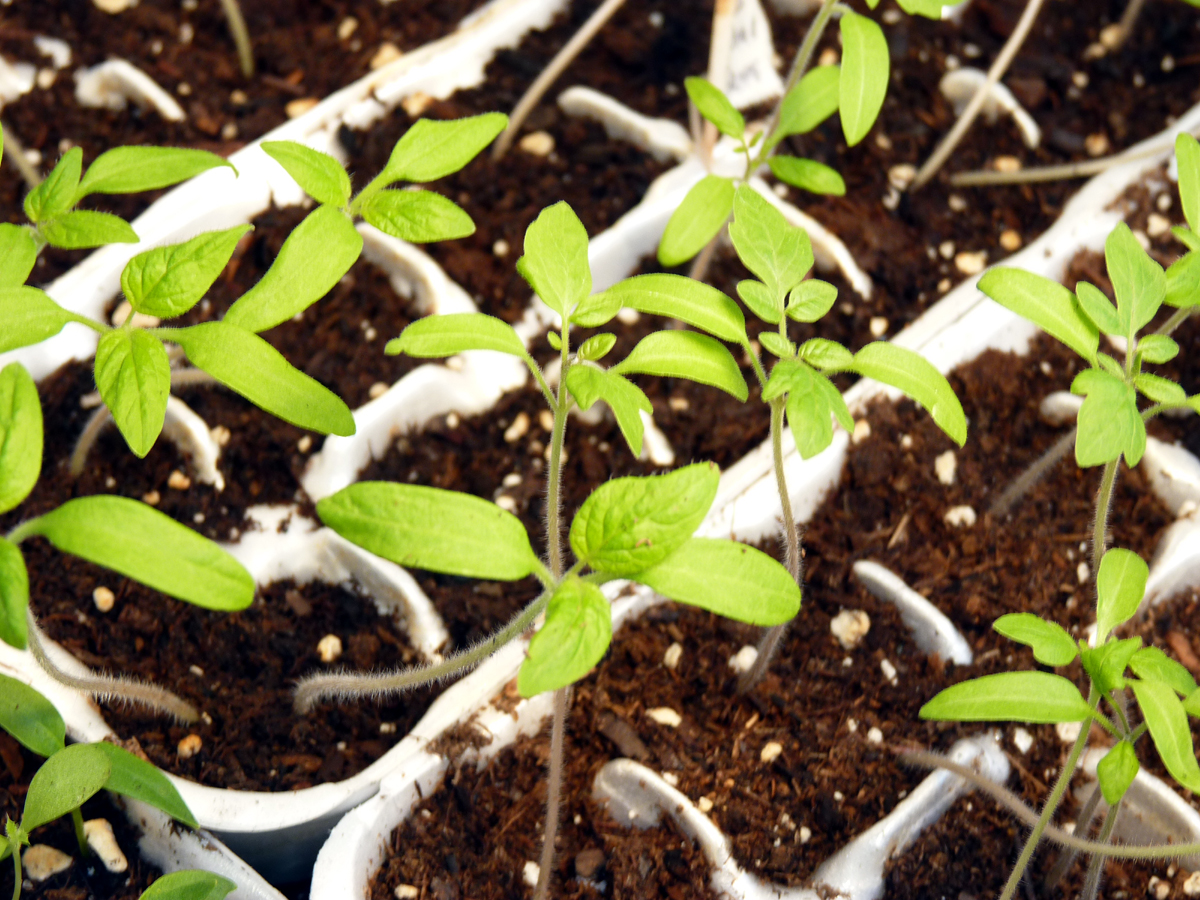 Tomatoes are ready for transplant when they have two sets of true leaves. These guys are already very close; I’ll probably be moving them into bottles in a week or so. My husband drinks a lot of bottled water and I drink a lot of Gatorade when I work out, so I’ve stockpiled the leftover bottles in our utility room. These were great planters last year. They let in light, they’re easy to remove when it’s time to plant and since they’re clear- I can see the root development on the plants and whether they actually need water or not. I’ll post updates when the seedlings are ready for transplant.
-B

 Belle of Dirt