Missouri Natives and Other Plants for Clay Soil

Tiger lilies or ditch lilies– 1-2 ft tall greenery with flower stalks up to 5ft. They flower for a month or more and require next to no care. Like irises, they will need to be thinned out about every 3 years or so for best bloom. They are often seen along the sides of roads (Hence the nickname “ditch lilies) or in sunny places near water.
I got mine from my friend Shane; we dug up about 20 plants from his mom’s old house when she moved. I now have literally hundreds of plants and could have more if I divided them more diligently.

Honeysuckle vine– I have three of them against the back wall of a large crescent shaped bed I built into a hillside. They smell amazing when they flower from Mid-May to June and the pink to vanilla flowers are very pretty and delicate in appearance. Without a climbing support, I’ve seen people grow these in their yards as shrubs. I’ve also seen plenty of them growing wild the same way. Also very low maintenance and seem to be one of the few things the deer leave alone in my yard.

Roses– Are said to do well in clay soils. Their roots are woody and strong enough to penetrate it, the clay provides the needed nutrients and deeper water supply that they crave and it prevents wind rock of the roots by giving them a strong anchor. I’ve personally only tried a few different varieties and have the best luck with climbers and wild roses. Most roses are too much maintenance for my taste, with their tendency to get black spot, powdery mildew and a host of other diseases and pest issues. I do intend to try some of the knockout roses in the future; as I hear that they require very little maintenance and don’t have most of the usual rose afflictions. If you’ve had good luck with them, share your experience, please!

Oriental Poppy– The big, red showy ones are best for clay. I’ve personally never grown them, but my grandmother had a small bed of them for years that absolutely flourished. They like full sun and tolerate the drier clay soils, not so well the wet, waterlogged clays. They also spread over time and will need to be divided when the clumps become overcrowded.

Hollyhocks– I’ve seen these grow prolifically in places where even some weeds feared to tread. My mom has them growing right out of the gravel in her driveway, next to her garage. The look great in rows or bunches and put out tons of seed each year (they are annuals). They do require plenty of sun and some water if the leaves begin to droop.
Purple Coneflower– 3-4 ft tall perennial, attracts butterflies, great for borders, wildflower meadows, prairie style gardens. It grows wild in Missouri, in fields and along roadsides. The plants bloom a long time before going to seed, from midsummer to fall. They are drought tolerant, relatively pest free and unattractive to deer. The most common colors in the wild are purple and white. There are also pinks, rose and a new orange variety. Will tolerate clay soils but thrives in well-drained average soils.

False Indigo– This small shrub is often found naturally in Missouri along streams and in the woods. The flowers are clusters of purple flowers, similar to those on Butterfly Bush. False Indigo is in the legume (bean) family; legume plants are able to help restore nitrogen depleted soils- they are able to convert atmospheric nitrogen into a form that the plant can use. I ordered about 20 False Indigo plants from the Missouri Conservation site several years ago. They’ve never had pest problems, require no maintenance, watering or pruning to stay healthy and are all thriving several years later.

Dogwood– Another shrub/tree that grows wild in our area. Mine came from the Arbor Day Foundation as bare root trees only about 6 inches high. I planted them directly into the ground, haven’t bothered to fertilize, seldom water and have only mulched them a couple times. It had a slow start, but after about 5 years, is now nearly 6 foot tall and seems to be well established. Dogwood trees bloom in spring near the end of April; they may have pink or white blooms, although the whites are much more common. The leaves will burn and shrivel in full sun. They are naturally under story trees and prefer at least partial shade.

Lilac– I got my lilac start from a friend’s large established bush. I dug up a small start, about a foot high with some root, brought it home and planted it directly in our yard; it tripled in size the first year with only a little watering and some mulch. It isn’t high maintenance, although it has had occasional issues with some powdery mildew on the leaves during especially hot/rainy summers. (A cup of milk in a gallon of water, sprayed on the leaves will help get rid of mildew spores) My only other problem with my lilac is that they are sometimes plagued by weevils. So far, I have only sprayed these with the water hose to discourage them from the plant and they’ve caused little damage. I’m not a fan of pesticides in the garden if it can be avoided.

Persimmon– These are a deer favorite when they fruit, so if you take issue with them being in your yard, I’d steer clear. I planted them in hopes that the deer would eat them instead of my other plants (the deer are coming in our yard regardless; we have 50 acres of woods in our back door). They also attract birds and other wildlife. Male and female trees should be planted near each other; they like the company and it’s how they have little fruits.

Redbud– I got 5 of these from the Arbor Day Foundation the first year we moved to our house. Most of them I planted directly into the ground in various places around our property, it’s taken them a long time to establish any real growth. Two of them however, I over-wintered in pots, brought out the following summer and then planted that fall. These two are now about 15 feet tall and absolutely covered in blooms every spring. One of them I had to stake until the roots were deeply established, it grew in height much too quickly for the small feeder roots to support the trunk’s weight. The only maintenance I’ve done to them outside of staking is an occasional watering and some pruning of the lower sucker branches.

Coping With Clay

Several years ago I had a website called ExistentialBelle.com on which I wrote several articles related to my yard work, plant growth and landscaping ventures. The website didn’t survive due to my then cluttering it up with too many personal things.

This is an article I had written for the gardening portion of the site- something I didn’t get bored with or outgrow. (I’ve edited a bit here and there as I saw fit)

Northern Missouri, where my family is originally from, is blessed with dark, rich, workable topsoil that is perfect for growing. Even in some of the cities near the Missouri or Mississippi rivers, such as St. Louis or Jefferson City, I’ve seen great topsoil; black silt that I’m guessing must have been deposited there over many years from the rivers long ago. However, here in my part of Missouri, which is the Lake of the Ozarks, our soil (if you want to call it that) is primarily comprised of two things: layers of rocks, followed by layers or clay on top of more layers of rock.

Our home, as well as many others in the area, is built on filled land. Most parts of the Lake Area are wooded hills, prior to development. In order to make the land relatively flat for building, they do what’s called grading it. This essentially means that they use bulldozers and other heavy equipment to scrape the tops off the surrounding hills and shove them into the valleys to create a flat area large enough to hold a house. It’s a common practice here, especially on the hillsides surrounding the lake itself. I’ve seen many a lake home’s back yard landscaped with small rock or gravel to cover the red, muddy mess the excavator’s left behind. Our yard was equally as scarred and ugly when we first moved in. The former tenants of our home didn’t see fit to do anything with the yard for the two or three years they occupied the house. The result of their neglect, combined with the complete removal of any topsoil by the excavators left a rocky, exposed clay mess that was suitable for growing only small patches of crabgrass, dandelions, thistles and a few other hardy weeds.

After many frustrating attempts to dig and plant in this stuff without success, I went into research mode to find ways to deal with my clay. Clay soil is manic-depressive. It has two states: Mud or Brick. You have to learn to manage these opposing conditions to reach a happy medium and say goodbye to clean tennis shoes and socks. I still have more than a couple pairs of shoes and socks in my closet, permanently stained a brick-orange color from working the clay in our yard. On the bright side, clay’s binding properties are wonderful for holding trace minerals and nutrients. The particle size is small and smooth; it holds water well and is very fertile for supporting plant life. If you ball up clay soil in your hand, it will stay in a tight, sticky ball that holds shape. The deeper layers are slow dry out and can support plants with deep, well established root systems very well. Trees like Oak and Dogwood especially favor clay soil. It also supports plant’s root systems to protect them from wind rock (a condition where the upper portion of the plant moves during windy conditions and causes the roots to lose their hold or become damaged).
The problem with clay is those same binding properties that make it nutrient and water rich can pack wet clay together into heavy, unworkable clumps. Lifting a shovel full of wet clay feels as if there is a toddler swinging from the end of it. Aeration (the ability to get oxygen to the roots of a plant) is often very poor. The top layer of clay soil can dry into a hard, cracked crust, while a few inches underneath remains bog-like. Steel tools can barely penetrate the stuff; small feeder roots drown in the lower layers, dry out and burn up in the upper portion of the soil.

The first couple years in our new house, I was desperate to treat the problem of the red mud being tracked all over our carpets and ruining pair after pair of shoes. Clay soil’s rotten drainage can result in a moat or lake in your yard for days after the smallest rain. Worse yet, unprotected slopes and hills can erode quickly into mudslides, washing away what little topsoil has accumulated there, compounding your drainage problem. When it does finally dry out, plants that grow in the upper layers or soil- such as all grass and many flowers- dry out and die quickly without at least daily watering. In its dry, concrete like state, clay is nearly impossible to get a shovel or a tiller into and with no plants to hold topsoil in place, dried clay is also prone to wind erosion and rock slides.

Since we were on a very tight budget those first couple years, I figured I only had a couple of options for fixing our red, two acre mess. Buy plastic alligators or pink flamingoes and pretend I lived in the Everglades during the spring season; replace them with plastic cactus and tortoises in the summer. OR– something a bit more practical, find a way to both soak up excess water and keep the top layer of earth from baking in the sun. It wasn’t the most elegant solution, but a thick layer or hay/straw solved both problems for a while. In the fall, I used a mulching mower to run over the leaves and left them on the yard. Straw, mulch and leaves thrown on top of the clay were only a temporary fix though. They were akin to the lake houses I’d seen swathed in landscaping fabric topped with river rock or gravel. They covered up the problem, rather than addressing it.

Re-routing water with ditches or drains, building raised planting beds and walkways helped some in the high traffic areas of our yard. It kept the mud out of the house and prevented walking on the already damaged areas so that some had a chance to recover naturally. The rest of my yard still looked like a giant stable. What a really wanted was some grass. I went through several bags of seed, which sprouted, lived briefly and died in the span of a couple months. Sometimes it hung on doggedly until the end of the season, only to give up the struggle over the winter months. The raised planting beds were doing fine, since I’d planted on top of the offending clay instead of in it. To these I had added a small amount of our clay to bag after bag of potting soil; not the most economical solution. The problem seemed overwhelming and too much for one person to manage.

I decided to divide our yard up into smaller portions and focus on one section at a time. My three greatest allies in my battle against the clay were several pairs of washable suede garden gloves to prevent blisters while digging, a mulching lawnmower and a large compost bin.

I’d read that additives were the best long term method of improving clay soil. They help to loosen it up, dry out the deeper layers and bring moisture to the crusty upper layers. Inorganic materials like lime, gypsum, vermiculite, perlite and oyster shell can be purchased at garden stores and used to loosen clay, making it workable. But some of these can alter the mineral content or PH balance of the soil and are also rather pricey. I’ve personally had the best results with organic matter. Compost, shredded leaves, newspaper, hair, eggshells, wood mulches, grass clippings, pine needles, hay, straw, vegetable waste and even coffee and tea grounds. Many of these add valuable nitrogen to the topsoil layer as well, while helping to loosen the clay and encourage plant growth.

Composting was a HUGE help in reforming my clay soil, accompanied with the mulching lawnmower, I joked to my husband that I was using our yard to fix our yard. You can pick up the grass clippings in a bag and add them to your compost pile, or just let them drop on the yard and decompose right there. Be prepared to spend a lot of time working the top layers of your clay, adding your organic material and then re-working as necessary. Ultimately, you’re trying to get the soil closer to a loam state, where it still balls when wet, but readily comes apart when squeezed. Ideal soil has a medium particle size, is full of organic matter, holds water well, but also has good drainage. The first few times you work your compost into the clay, you may not be able to penetrate the soil very deep without major effort. Give the compost some time to do its work (and by this, I mean you may need to give it a several seasons to see serious results).

Organic additives will attract earthworms too; they will further aerate the clay and break up the stickiness of it. After a few treatments like this, you should be able to work the soil at deeper levels.  Remember that this is an ongoing process, not a do it once and forget it kind of fix.

Plants can also improve clay soil. Choosing native plants (ones that grow in your area naturally) will help to ensure their success. Clay soil is slower to warm in spring and plants will take longer to become established, but they often do well with minimal intervention once they are settled in. Established plants can help by breaking clay up with their roots and by drawing moisture up to the dry upper layers. Watering your plants in clay can require a bit of finesse as well. Since its small particle size packs tight and doesn’t readily absorb water, you should water for short intervals over a period of time. Let the sprinkler run for a few minutes, turn it off and allow the surface water to soak in, then turn it on again and let it run for a few more. This gives the upper layers some time to soften up and absorb the water down to your plant’s roots rather than just pooling on the surface or running off.

For those of you in Missouri, the Missouri Department of Conservation is an excellent resource for trees and shrubs that will grow well in all types of Missouri soil. I’ve ordered several shipments of small seedlings from them over the years and most of them have matured nicely.  I will caution you that if you are very particular about what you’re getting, then you should order EARLY. They often run out of the more popular stock very quickly, especially the fruit/nut/flowering trees and shrubs. I don’t know if other States have similar programs, but this one has been a wonderful resource for our yard.

The Arbor Day Foundation’s website is another economical place to buy small trees and shrubs. ( I think they now even have some flower packages.)  Both sites send their plants as bare root stock, meaning they are only 6 inches to a foot tall and come wrapped in paper or plastic rather than planted in pots of soil. They give instructions for “heeling in” the plants when they arrive. I’ve found that with my clay, my plants are often more successful if I place them in pots of garden soil or potting soil for the spring/summer season, allow them to establish strong root systems and then plant them in the yard that fall. Stock I’ve received in the fall, I over-winter inside in small pots and usually let them spend the Spring/Summer season in their pots outside before giving them a permanent Fall home.
I will do a separate article soon with specific plants that can prosper in clay soils and also elaborate on composting methods.

B
Getting Dirty

A blog that calls itself “Dirt” needs at least one post on the subject, don’t you think? So this post is about just that: dirt.
Dirt/soil is the most basic and also one of the most important building blocks of your yard or garden. It doesn’t just hold the plants in place; it gives them the nutrients they need, absorbs and collects and it protects the root system of the plant from sun and cold. Most plants grow in some type of soil. The exceptions to this rule are air plants, such as orchids that absorb nutrients through the leaves; roots are used as anchors only, usually to other plants. Some water plants do not need to root in soil, but get their food from the water. Or one of my favorites; plants like the Venus Flytrap that survive in very poor nutrient soil or watery bogs with little to no soil by ‘catching’ their food in the form of insects. Hydroponics, plants grown in controlled conditions in nutrient rich water, is another form of soil-less growth.

For most plants you buy in your local nursery though, they are going to need dirt. The nursery tag on the plant should tell you what type of soil it prefers. Like almost all living things; plants need air, light, water and food to thrive and grow. Good soil is one of the most important steps in the health and success of a plant. Some plants will not only do poorly in the wrong soil type, they will simply not survive.

This doesn’t mean that if the plant you want to grow doesn’t match the soil type in your yard, it is automatically off limits to you. It most cases, it simply means you’re going to have to adjust or amend your soil to meet that plant’s growing requirements.

There are three basic soil types: Sand, silt and clay. Each of these soil types has a different particle size and holds water and nutrients in a different way. If you aren’t sure what you have in your yard, one of the easiest ways to test it is by feel. Pick up a handful of wet soil and try to form it into a ball in your hand. If the ball falls apart easily, you have a lot of sand. If it forms a loose ball, it’s silt. If it forms a semi-solid, sticky ball, you have clay. Of course, I’m over-simplifying a bit here, but this is after all, a blog post and not a book. Give or take specific mineral content, the vast majority of plants prefer a moderate silt-type soil. If you have one of the other types, your goal will be to amend it until it resembles silt as much as possible. This usually means adding some form of organic matter to the soil.

Sand– Has a large particle size, feels rough when rubbed between your fingers, but doesn’t hold nutrients well. Sand usually provides good water drainage.

Silt– Has a moderate particle size, feels powdery when dry/smooth when wet, but not sticky. It holds nutrients and water well; it’s usually the preferred growing medium for the majority of plants.

Clay– Has a small particle size. It can turn to a brick when dry and is sticky when wet. Soils with high clay content are called heavy soils. Clay can hold a lot of nutrients, but drainage and air circulation is often poor.

There are many options when it comes to soil amendments. It’s not recommended that you try to adjust your sand or clay soil by simply adding clay to sand or sand to clay. This is a recipe for cement, not so great for plants. Your best bet is to add organic matter, or some form of man made additive or fertilizer. You can buy all sorts of things to improve your soil at your local nursery or garden center such as bags of humus, peat, vermiculite, chemical and natural fertilizers and so forth. I stay away from the majority of these for two reasons: 1) They are expensive and 2) I don’t like chemicals on my lawn/plants/food, etc. I prefer to use natural materials and make my own compost. I’ll write a more in depth post on the compost subject later, but for now I’ll just say this can include leaves, yard clippings, newspaper, vegetable scraps, etc. You break them down in a compost pile or drum, bucket, bin, what have you and just mix them directly in with your soil.

Another option if your soil isn’t quite perfect is to grow on top of it rather than in it. By this, I mean building raised beds, using planters, pots, or some other method of getting your plants out of your native dirt and in to purchased potting soil or garden soil instead. More expensive than composting, but often a lot less work and can require a great deal less patience. I’ll also try and revisit this subject later, as I’ve spent a good deal of time building raised planting beds around our yard.

Once you have the consistency of your soil right, meaning you’ve added material to it so that your clay or sand feels more like silt, you’ll then need to adjust the content for nutrients such as nitrogen, phosphorus and potassium depending on the plant’s individual needs. (Yet another subject that could be addressed at length…)  Commercial soil additives will usually list these nutrients on the bag and their concentrations in percentage form. Nitrogen helps leaf growth and dark green color, Phosphorus encourages plant cell division, flower and seed formation, root growth and protects plants from disease. Potassium increases plant’s disease resistance, encourages root growth and is needed for making chlorophyll.  You can buy soil testers to test the amount of specific nutrients in your soil if you feel your plants are suffering from a lack of one of the above. Testers can also help you with adjust soil Ph, which is especially important to the health and production of some plant types.

A Ph range of 4-9 is about the limit of plant growth. The Ph scale runs from 0.0 being the most acidic, to 14 being the most alkaline. You don’t need to be a chemist to adjust soil Ph. An application of lime and fertilizer will lower the Ph of acid soils, or if your soil is too alkaline you can apply sulfur to lower the Ph. Before home soil tests were readily available, some farmers would actually taste their dirt to see whether it was ‘sweet’ or ‘sour’. If it had a soap taste, they knew there was some lime in it and if it was sour, they knew it was acidic. Sand and loam require less lime/sulfur to raise or lower Ph than is needed to adjust clay.

Those are the basics on soil/dirt. As I said a couple of times above, I’ll expand later on several of the points I touched on in this post; this gave me sort of a jumping off point to start from. For those of you that have clay soil, keep reading… it’s one of my favorite gripes- er… subjects. I’m sure to have lots more to say on coping with it later.

Fencing

In the past eight years since buying our house we’ve done a major yard project almost every year, with the exception of the past two, during which I was pregnant and then subsequently taking care of a newborn. A fence around the back yard was this year’s project, inspired by our daughter, who is now an energetic, exploring toddler.

When we first moved here in March of 2002, the so called back yard was a roughly 20×20 area of red clay mud and three large dirt piles left behind by the excavator who I assume leveled that area for the house. Because it was built on fill, this part of the yard sharply drops off to a ravine on one side and the previous level on two other sides; all three slopes covered in blackberry briers or wild roses (equally thorny in either case), Poison Oak, Staghorn Sumac and other fun things. This wasn’t really a problem until we had a small person who didn’t realize that A) gravity will send you rolling down hills into ravines and B) thorns hurt soft baby skin.

So this year I cut the wild roses back from the yard and we built a fence to give baby a boundary from that dangerous edge. I dug holes for the corner posts as deep as I could get them, which only turned out to be 20 inches maximum. Three feet is the actual frost line minimum in Missouri if you are burying water lines of any sort, but we aren’t putting in irrigation, we’re just trying to prevent frost-heave on our posts.

We used an 80 lb bag of concrete on each post, so hopefully there is enough concrete and they are just deep enough that this won’t be an issue. All of our soil is heavy clay also- a soil not that susceptible to frost heave as say a sand or silt would be.

I picked up 5×8 round fence posts from the farm store as opposed to using 4×4 lumber because I thought they looked better. They were about the same price as a 4×4, about $7.00 per post. We used these for the corners and anywhere in the yard there would be a bend that would create a lot of stress on the fence. Getting these in the ground in between running after the baby to keep her out of trouble took us about 4 hours from digging the holes, to setting all the posts. The last post closest to the house we had to bolt to the house’s frame; I hit a concrete pad or ring that I assume is part of the foundation of the house and couldn’t get into the ground more than 8 inches or so.

For in-between posts we used green metal T-posts, which are the ones you often see around farmland with barbed wire. They pound into the ground with a heavy metal tube that has handles on either side. This part of the project proved to be the hardest on my husband, who literally ripped the skin off his hands in multiple areas on the tool. I’m sure there is probably a mechanical alternative to this, however, in the interest of saving $, we didn’t even look into it. The brute force bashing-thingy was less than $20.00.

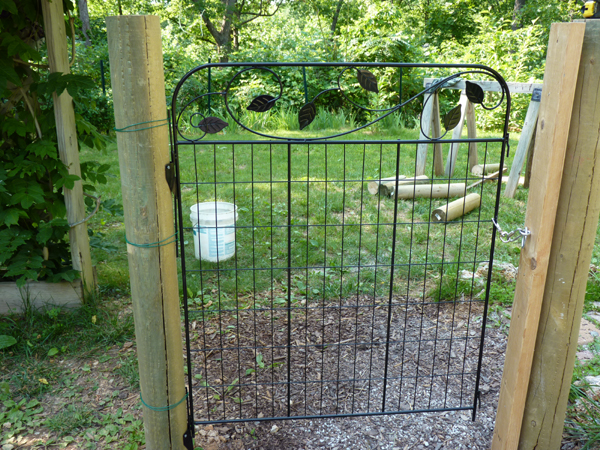
The second day of the project, we hung the fence itself. Chain link was cost prohibitive and also would have required a stretcher and other tools we didn’t have, so we opted for vinyl coated garden fence instead. Not as sturdy as chain link, but it serves its purpose as a barrier for a two year old quite nicely and the green practically disappears against the plants so it’s not intrusive as looks go. Tom used tomato staking wire (which is also green, vinyl coated wire) to attach the fence to the posts while I stretched it taut.

The front gate is actually a portion of decorative metal fencing that came in a package of two interlocking pieces for $20.00. We used one for the fence gate and the other to gate our deck stairs. In retrospect, the cost savings on these gates may have been overshadowed by the cost of cobbling together hardware in order to secure them to the posts and create a latch. But they worked out, regardless and the bonus is, if I decide I don’t like the latch, I can change it with a different piece of hardware in seconds.

Overall, the project took about 8 hours and cost us around $750.00.

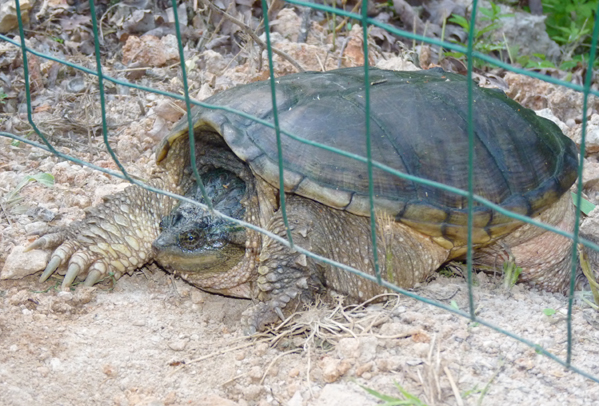
And we had a visitor to our fence the day after it was finished 🙂

Summer Pool Project

This has been one of our ongoing projects in the yard, improving year by year as we added structure and found out what worked well and what didn’t.

We started with an Easy Set pool, one of those with the inflatable ring around the top. We just sat it on the ground on the tarp that came with it and filled it up. The pool wound up being more than slightly lopsided, but got us through the season. We did have one “incident” in which Tom rode his raft out of the pool on a wave of water and wound up still on the raft outside the pool. I’m not admitting guilt, but I may have been bashing his raft and helped it go over the side. And I may have been laughing so hard when it did that he nearly washed down the hill because the pool was still dumping water on him. But there were no witnesses; so really, it’s just his word against mine.

Which reminds me, if you have one of those pools with the inflatable ring around the top, be careful about squashing the ring below the water-line. The force of and weight of all that water is enough to push the ring down even further and drain half your pool in a matter or seconds.

Because of the prior year’s excitement, we decided the next year that the ground needed some leveling and that perhaps a privacy screen was in order as well. (We live on a very busy major highway) I used our garden tiller to remove at least a foot of earth from the back side of the pool area. The removed earth I re-used on the other side of the house to build raised flower beds.

Tom built a frame of treated lumber and attached to it an upright frame for lattice screens. These were a nice start for a privacy fence, but the lattice being the slightly flimsy kind- didn’t stay up very well and I spent the next two years re-attaching it to the frame. Finally I grew tired of struggling to keep it on and bought three wisteria plants to plant along the outside edge of it. These have now wound themselves through the trellis to such a degree, I’m confident that it’s going nowhere. It would likely hold up to storm winds better than the siding on our house. The wisteria will need to be trimmed often to keep its growth under control, (it’s a VERY aggressive vine) but it solved my problem of the lattice falling off and added another layer to the privacy screen.

Our inflatable ring pool became inflicted with a slow air leak that we never could find, so we finally replaced it with a tube framed one instead. It was about the same price and is MUCH more stable; also little danger of someone going over the side on a float and winding up in the woods. Before we set up this new pool for the season, we ordered a truckload of sand for the bottom frame. I spent several hours with a fine leaf rake, removing every tiny rock I could find, and then filled the frame with sand to around 3-4 inches. For the most part, the sand has held for the past two years. It will probably need a touch up fill next season. I have to weed it periodically; a nice layer of weed barrier under the sand might have saved me some of this; however cost was a real concern when we started this project. This year I used an old bench for a plant stand and brought some of my indoor plants outside to set around the pool. I have a yucca, some elephant ears (newly planted), my spider plant and Christmas cactus (which is currently full of blooms and adds a nice touch of color). I like the plants in pots this way, they are easy to rearrange and I can move them out of the way when I need to weed or mow. For now, I’m calling this project complete.

In the future I may add some more landscaping around the outside of the frame or a walkway from the back steps to the sand frame. Or I may add a second smaller frame off the first and build our daughter a sandbox to play in. Maybe a rope border, sunken treasure chest…

🙂

Cold Hardiness and Microclimates

A cold hardiness zone is the maximum temperature range that a plant can survive in during the winter months. North American Zones range from Zone 1 (being the coldest), below -50F in Fairbanks, Alaska and some Northwest Territories of Canada to Zone 11 (the warmest), above 40F in Honolulu, Hawaii or Mazatlan, Mexico. To find your zone on the map, you can look here: USDA Plant Hardiness Zone Map

I live in Central Missouri, the bulk of which falls under cold hardiness zone 5b, which is -10F to -15F. Some nursery tags will picture a little temperate map showing your zone, others will simply list the cold hardiness temperature under a list of growing conditions. Perennial plants within this range should be able to return each year after a period of dormancy. Plants outside of this range will have to be planted as Annuals, meaning you’ll need to replace them each year.

Although Central Missouri is in Zone 5b, my specific area is in a small pocket of 6a to 6b. On gardening shows, they’re referred to as microclimates.  I’m not sure if maybe this is an effect of the large lake here, but it means that I can often get away with growing plants that surrounding areas cannot. We have varying micro-climates in our yard as well.

For years I had grown a row of Elephant Ears along the front of our house (Zone 10 plant minimum), never bothering to dig them up in the fall and store them inside to over-winter as was recommended. I covered them with leftover plastic bags that my fall mulch came in and then left the fallen leaves to cover the plastic until late spring early summer. For nearly 7 years, they came back every June, in spite of everything I’d read to the contrary.

Excuse me… my daughter is in my houseplants eating dirt…

Ok, where was I? Oh yes, Elephant Ears. I experimented with some more out in the yard itself; these did not return the following year as the ones next to the house did. My guess is that the house itself radiates enough heat right up next to the foundation that it was enough warmth to keep the other bulbs alive, though dormant through the winter months. So even though most of my yard may be Zone 5-6, this one particular 2ft x 6ft area is more like Zone 8-10.

Of course you have to take care of how far you push your luck. I bought a Crepe Myrtle last year that said it would be fine in Zone 6, and then we had several particularly cold days in January that caused it to die back to the ground. I lost the entire top of the plant that wasn’t covered by dirt and mulch. If I don’t want a repeat performance during another severe winter, I’ll now have to move it to a large pot and over-winter it in the house along with my house plants. Since its roots will always be bound by the confines of a pot, it’s unlikely it will become the large, lush tree like those I admired growing in yards during our visit to the Carolinas and Georgia several years ago.
The best way I’ve found to figure out what works and what doesn’t in regards to cold hardiness is to just experiment. I recommend starting with something small, like a couple inexpensive bulbs, or maybe some perennials that you’ve found on sale and wouldn’t be too upset if you lose them. Once the plant has performed well consistently for several years, it’s probably a safe bet to assume the temperature will remain fairly constant there from year to year.