A tale of 2 trees

Very simple testament to the power of mulch for your plants:

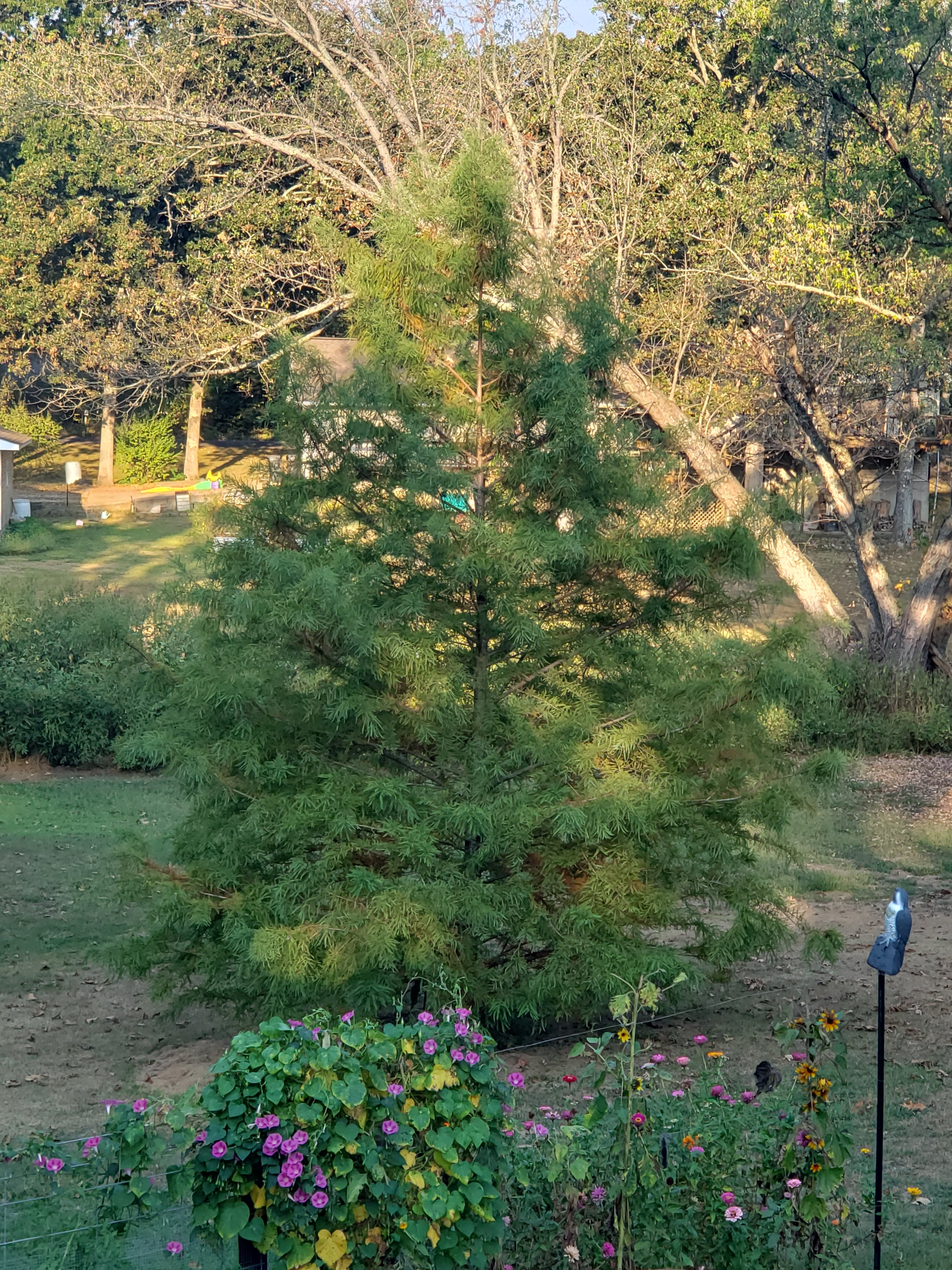
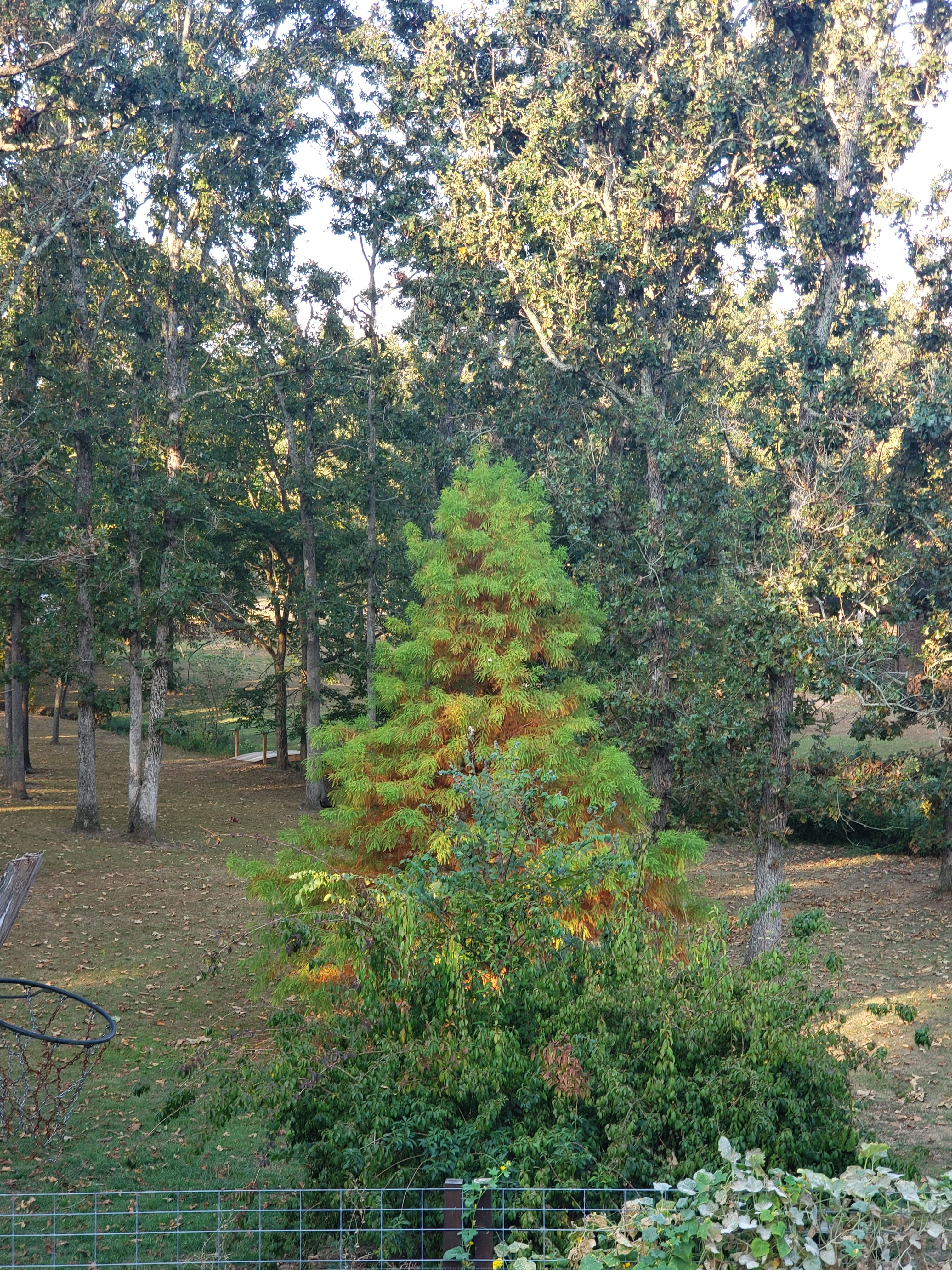
Tree on the left has no mulch under it. It even sits in a low spot in the yard where all the rain runoff travels.
Tree on the right I blew all the grass clippings under with the lawnmower a couple months ago, so it has a nice, thick layer of mulch under it.

In our part of Missouri, we’ve had little to no rain for over a month and a half now. My neighbor’s oaks were showing signs of oak wilt when we moved in here a year ago, now they’re disappearing like seedlings in a rabbit’s garden buffet. Half the trees in our neighborhood are dropping leaves and going dormant. It looks like November on the ground already. The dogs send puffs of dust flying every time they run. Our water bill that normally runs $30 a month was $142 last month. I wouldn’t even want to see the neighbor up the hill- who have the only green yard in our subdivision and run their impact sprinklers at least 10 hours a day from dawn to dusk every single day.

The only real blessing is I haven’t had to listen to lawn mowers all around us every weekend… but it’s been replaced by the sound of chainsaws cutting down dying trees and clouds of dust from stump grinding. I think I preferred the lawn mowers. 😦

So anyway, moral of this story is, MULCH YOUR PLANTS. If you can’t deal with the messy way it looks, then put landscaping around them, like the plastic yard dividers, landscaping bricks, rock, etc. and put the mulch inside that contained area. But mulch your plants. It doesn’t just conserve water. It keeps the roots cooler in the heat, it protects the plant from the brutality of the sun beating down on it. It keeps the soil from compacting and allows air exchange and microorganisms to enrich your soil. It attracts earthworms and it breaks down over time, building topsoil, creating nutrients and feeding your plants. It keeps the weeds down. (Anything that cuts down on my weed eating time is a good thing!)

My neighbor hates mulch. He wrinkled his nose at me last fall when he came over and asked me if I’d like him to vacuum up all the weeds and grass clippings- and I told him, “No thanks, I’ll chop them up and use them for mulch.” I was dumping bags of them around my trees when he stopped by. His granddaughter said, “What’s mulch?” He pointed to what I was doing and said, “That.” He was absolutely disgusted. He mows and uses Round Up at the base of all his trees to make nice, neat little clean rings under them with no weeds. He wants his yard to look like a city park.

His trees are the ones being cut down now because they’re dying.

-B

Gardening In Suburbia

Sigh… Ok, I know it’s been months again since I’ve made a post, but I haven’t really had much TO post about. Work, hang out with my husband and kid- wash, rinse, repeat.
Plus, as most of you know, I moved last August to Suburbia and left the orchard and garden I’d put seven years into behind with my ex husband. It’s ok. I’m not feeling sorry for myself and I don’t regret that decision AT ALL. Not one miniscule little bit. It was a lot of work, I had little to no help and even though I had all that space, land and time, it wasn’t fun anymore.

20250518_1256267418872883032275217

Danny bought us a gorgeous house with a massive yard last August. The only caveat is, it’s in the middle of a suburban neighborhood- something I haven’t lived in since I was in my early twenties and didn’t care that my “yard” basically amounted to a square of dirt under the windows of our apartment, which was taken care of by the landlord and surrounded by a half acre of concrete. It was close to the hospital where I worked. I had pizza takeout and a ready access to all the Diet Dr Pepper I wanted. I had house plants. I was good with that.

But we moved here and I missed my garden. The ground here sucks. It reminds me very much of the ‘soil’ at our house at Lake of the Ozarks. Clay with layers of rock, more clay, more rock and it’s either dried out concrete texture or sticky muck that roots drown and suffocate in. So we decided if we’re having a garden here, it will need to be like it was there: raised beds that sit on the hard, crappy ground instead of spending hours upon hours amending the soil IN it.

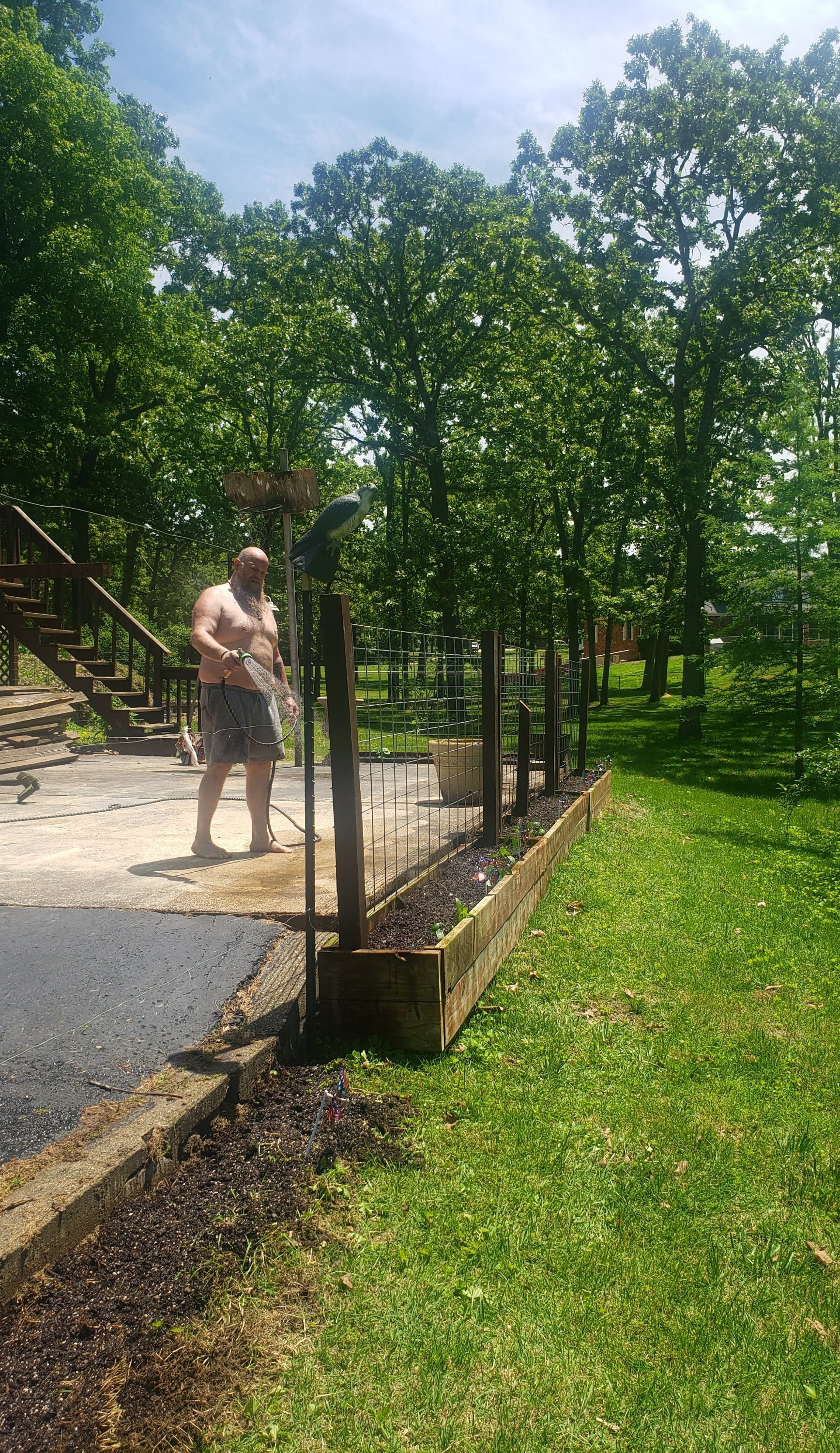
Our deck needed to be replaced and we had a bunch of leftover lumber that needed a purpose, so Danny built me boxes. ALL THE WAY around the patio. And this is a HUGE patio. Each one of these boxes is about 10 feet long, over a foot wide and about two feet deep… and he built four of them! So I now have more garden space than I’m sure I know what to do with. Ok, to be fair we did manage to fill every single box with plants, but that’s beside the point. The point is, I have a massive garden. And my husband is a freaking rock star who goes out of his way to make me happy.

He built all of this over a couple weekend’s time. The bottom of the boxes are lined with cardboard (leftover from our move), topped with brush, sticks, yard clippings and leaves. The other neighbors burn every leaf and cut blade of grass that falls on their lawn. I probably drive them batshit crazy.

He added posts and trellis and took me plant shopping. HE TOOK ME PLANT SHOPPING!!! I made a joke about needing to buy 87 plants and he just shrugged and told me whatever made me happy.

See? I told you. Freaking rock star.

So we planted all of this and then had to go back out and put some of the seeds back in the ground after the neighborhood band of marauding squirrels decided they wanted to play in the dirt and dig up a bunch of the plants. I’m threatening to purchase a slingshot, but haven’t yet, so Danny put electric fence around it. So far, the plants have been left alone for the most part and our dog has only been dumb enough to put her nose on it twice. >.<

I have tomatoes, okra, several kinds of beans, several kinds of cucumber, squash, zucchini, sunflowers. I haven’t the first inkling how to cook squash, zucchini or okra, but Danny assures me that he can and he will show me. I’m just over the moon that I have a big garden to fuss over again. And it’s right out the back door. Talk about convenience! And doubles as a privacy screen from the neighbors. We plan on rebuilding the deck soon, but until we do, I will have a nice little spot to sit behind my plants.

My daughter also got me a wisteria for Mother’s Day. A plant I had at the Lake but was forbidden by my ex to have at the farm. She told Danny she was buying me a wisteria… he said, “Good, she’ll love that.” 🙂
Told you. Spoils me.
Not sure how he’s going to feel about modeling for Dirt. We’ll see? Better to ask forgiveness than permission? 😉

I’ll keep you updated on how all this turns out. I’ve never had to garden while paying a water bill before, we had well water both at the lake and the farm. I did at least build layers into these beds, so they should hold water well, especially as they break down over time.

Happy gardening!

-B

Tree Wells In Clay Soil

We’re now into that part of summer in Missouri where just stepping out of the air conditioning onto the front porch is like walking past the mouth of Hell.
Ok, I may exaggerate a bit, but July and August here can be insanely HOT.

When I lived at Lake of the Ozarks, I often found it funny how tourists from Texas, Arizona and New Mexico would complain about how hot and sticky our summer’s were, when they routinely saw temperatures upwards of 100’s in their own states. However, Missouri can easily compete with several of the southern states in terms of humidity. I think it’s all the vegetation here, it holds humid like the Amazon jungle.

So my point is, it’s hot. That means all attention in the garden now shifts from planting new things to just trying to keep the things I’ve planted alive. Every year I have the same conversation with my husband about this time.
Me: “I’m not buying a bunch of trees next year, there’s just too much to take care of!”
Tom: “You say that EVERY year. Then you order 50 more trees from the Conservation site.”
Me: “I know. But they take hours to water, this is just ridiculous.”
Tom: “You say that too.” To which I usually give a non-committal grunt and go back outside to haul more water buckets. He’s right, I know he’s right, but when those plant catalogs show up in my mailbox every fall and I’m already longing for spring before fall even really sets in, it’s hard not to get the trees and worry about the repercussions of my impulse plant buys later.

Baby trees

Is there a rehab for tree addiction?

My biggest disappointment is that after all that work to get the trees and get them in the ground, it’s hard to keep them all alive until they get deep enough roots to mostly fend for themselves. New trees need consistent watering- at least once a week during normal rain, maybe every other day to daily during the hot, dry months of summer that we’re in now. I have trees scattered over 40 acres worth of land, so as you can imagine, I don’t have enough watering hose to reach them all. Our orchard is currently without a water-source also, so that leaves a lot of water bucket hauling all through July/August and sometimes September.

My second issue is our soil. The Farm at least has topsoil, which I didn’t have at our Lake house, unless I put it there, but dig down more than 6-7 inches and there is still clay. It’s deep clay with blessedly little rock (the Lake soil was layer on layer of rock), but still clay. I have yet to get a cherry tree to survive in this stuff. I’ve tried building the soil up so they get better drainage, I’ve tried adding composted material, manure, etc. to loosen up the clay. They do well for a bit, then just wither and die. Cherries apparently need their roots to be able to breathe well, they are not fans of dense, compacted soils.
Clay can be a blessing and a curse. It is usually not lacking in nutrients because it holds them in place, rather than letting everything just run through as sandy soil does. Conversely, it can turn to concrete when it dries out, making it near impossible for small, fragile roots to push through. It can also hold water TOO WELL, turning the ground into a boggy, sticky mess that fragile roots drown and suffocate in. Hence my cherry tree drama. I could just content myself to buy less picky trees, but that will never happen.

20200714_152936.jpg

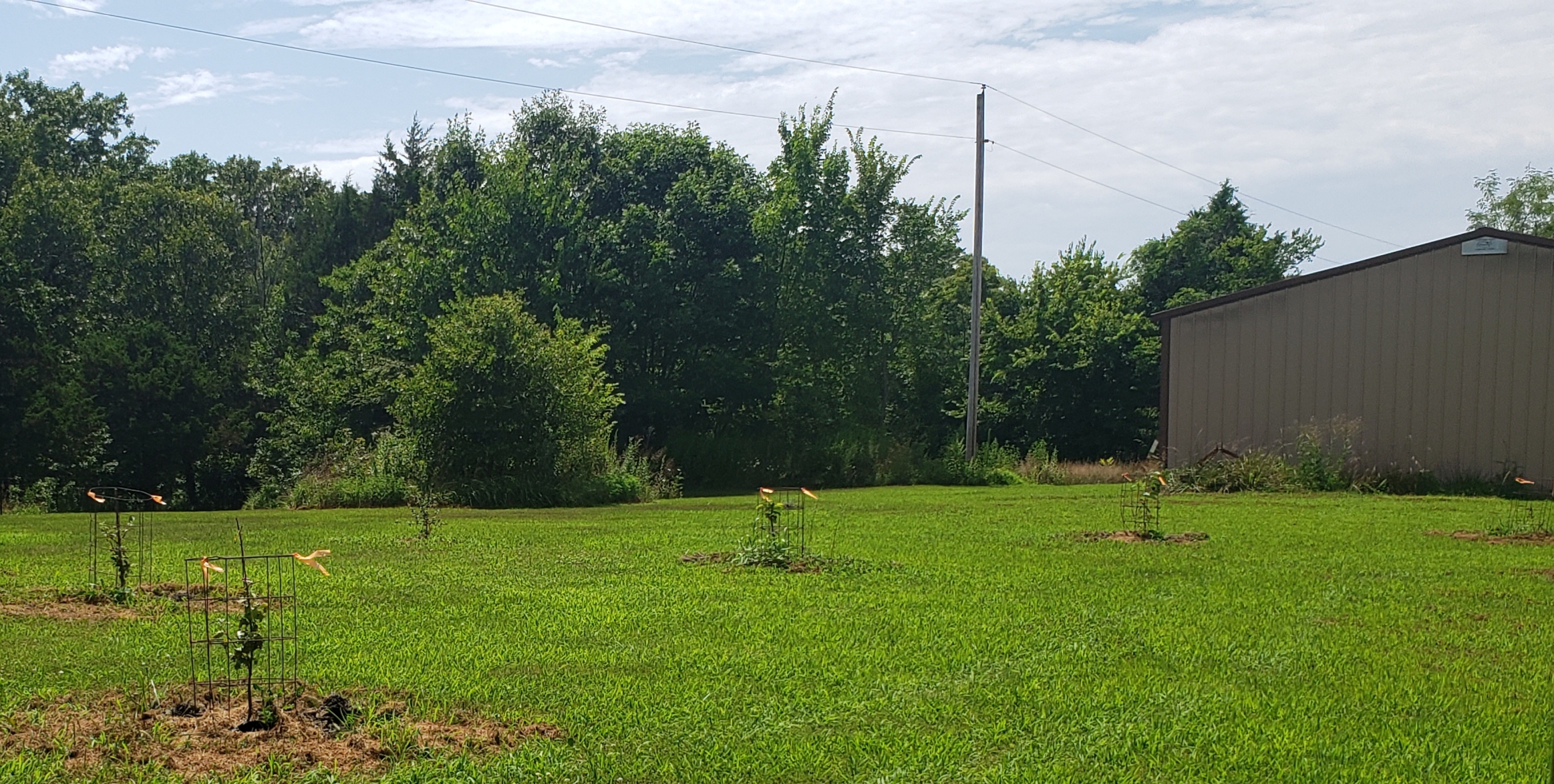
A two year old plum tree

The cherry dilemma distracts me. For my less picky baby trees, I’ve found a way to use the clay to my advantage. It was a bit more work in the beginning and won’t keep me from having to water at all, but hopefully will cut down on the frequency of having to haul buckets and improve the survival of those tiny little trees.
Mulch helps. I can’t preach the benefits of mulching plants enough. It holds warmth during the cool months, keeps roots cooler in the hot months, retains moisture, blocks weeds and some mulches improve soil condition as they break down over time. If you’re going to spend money on something in your landscape, spend it on mulch.
It helped my little trees some, putting down weed barrier and mulch.

Still, every time I hauled buckets, I had to pour a little of the water near the roots, then wait. Pour a little more, then wait. Clay soil doesn’t immediately absorb water. It soaks in VERY SLOWLY, so if you just dump the bucket of water over your plant, 90% of that water is going to run off where you didn’t intend it. Soaker hoses are great for clay, but that’s if you can get a soaker hose to that spot.

20200714_153222.jpg

My weekly summertime routine.

An armadillo dug up one of the new redbuds I’d planted down by our pond. Luckily, the little tree didn’t die (redbuds are TOUGH), but even after I re-covered the roots, there was still a substantial dip in the ground next to my tree. I dumped the water in the hole and noticed something. The water filled hole drained very slowly, held a lot of water and was still slightly damp the next day when I went back to make sure the tree hadn’t been dug up again. I had a new willow that wasn’t getting enough water, so I dug a hole next to that tree too and filled it with water. A couple weeks of that and the willow was looking MUCH better. I also noticed the redbud that the ‘dillo had dug up was looking fantastic, while a couple others I’d planted were either dead or barely hanging on.

20200714_153032.jpg

Digging mini-wells

In clay soil, these little holes were acting like a well. The clay held the water in place for a long time, allowing it to s-l-o-w-l-y filter down to the tree’s roots, instead of 90% of the water running off down the hill. Our farm ponds were built from packed clay bottoms. Eventually the clay particles pack together SO well with all that water weight on top that the water stops seeping through altogether and POOF! You have a farm pond.
All of the baby trees I’ve dug wells next to have improved. With mulch added, I may only have to water them half as much, even here in the mouth of Hell.

20200714_152958.jpg

Wells dug into clay will slowly release water for hours

The holes I’m digging aren’t super deep and I’m mostly doing this on trees less than a year old. However, I did add a couple holes near our peach trees, which are 3-4 years now. If you DO add wells next to older trees, be sure to dig at the edge of the root-line. As a general rule, the roots of a tree will reach out at least as far as it’s canopy spreads. I dig just outside the shadow it makes on the ground. If you dig into the roots, you can risk damaging the tree or introducing insect damage or fungal diseases.
I put the shovel into about 7-8 inches or so and pull out a clump of earth. The resulting hole will hold about 2 gallons of water. It takes 15 minutes to an hour for mine to completely drain if it’s really dry out. Once the clay absorbs some water, it will absorb more water faster, so if I’m in a hurry I make a second pass on slow draining holes.
With wells dug, I don’t have to slowly pour water at the root of the plant and wait for it to absorb, I just fill the well and move on to the next tree. It cuts my watering time WAY down, which means a lot less time in that headache inducing heat.

Now if only I can resist the impulse when those tree catalogs arrive this fall…. 🙂

-Belle

Coping With Clay

Several years ago I had a website called ExistentialBelle.com on which I wrote several articles related to my yard work, plant growth and landscaping ventures. The website didn’t survive due to my then cluttering it up with too many personal things.

This is an article I had written for the gardening portion of the site- something I didn’t get bored with or outgrow. (I’ve edited a bit here and there as I saw fit)

Northern Missouri, where my family is originally from, is blessed with dark, rich, workable topsoil that is perfect for growing. Even in some of the cities near the Missouri or Mississippi rivers, such as St. Louis or Jefferson City, I’ve seen great topsoil; black silt that I’m guessing must have been deposited there over many years from the rivers long ago. However, here in my part of Missouri, which is the Lake of the Ozarks, our soil (if you want to call it that) is primarily comprised of two things: layers of rocks, followed by layers or clay on top of more layers of rock.

Our home, as well as many others in the area, is built on filled land. Most parts of the Lake Area are wooded hills, prior to development. In order to make the land relatively flat for building, they do what’s called grading it. This essentially means that they use bulldozers and other heavy equipment to scrape the tops off the surrounding hills and shove them into the valleys to create a flat area large enough to hold a house. It’s a common practice here, especially on the hillsides surrounding the lake itself. I’ve seen many a lake home’s back yard landscaped with small rock or gravel to cover the red, muddy mess the excavator’s left behind. Our yard was equally as scarred and ugly when we first moved in. The former tenants of our home didn’t see fit to do anything with the yard for the two or three years they occupied the house. The result of their neglect, combined with the complete removal of any topsoil by the excavators left a rocky, exposed clay mess that was suitable for growing only small patches of crabgrass, dandelions, thistles and a few other hardy weeds.

After many frustrating attempts to dig and plant in this stuff without success, I went into research mode to find ways to deal with my clay. Clay soil is manic-depressive. It has two states: Mud or Brick. You have to learn to manage these opposing conditions to reach a happy medium and say goodbye to clean tennis shoes and socks. I still have more than a couple pairs of shoes and socks in my closet, permanently stained a brick-orange color from working the clay in our yard. On the bright side, clay’s binding properties are wonderful for holding trace minerals and nutrients. The particle size is small and smooth; it holds water well and is very fertile for supporting plant life. If you ball up clay soil in your hand, it will stay in a tight, sticky ball that holds shape. The deeper layers are slow dry out and can support plants with deep, well established root systems very well. Trees like Oak and Dogwood especially favor clay soil. It also supports plant’s root systems to protect them from wind rock (a condition where the upper portion of the plant moves during windy conditions and causes the roots to lose their hold or become damaged).
The problem with clay is those same binding properties that make it nutrient and water rich can pack wet clay together into heavy, unworkable clumps. Lifting a shovel full of wet clay feels as if there is a toddler swinging from the end of it. Aeration (the ability to get oxygen to the roots of a plant) is often very poor. The top layer of clay soil can dry into a hard, cracked crust, while a few inches underneath remains bog-like. Steel tools can barely penetrate the stuff; small feeder roots drown in the lower layers, dry out and burn up in the upper portion of the soil.

The first couple years in our new house, I was desperate to treat the problem of the red mud being tracked all over our carpets and ruining pair after pair of shoes. Clay soil’s rotten drainage can result in a moat or lake in your yard for days after the smallest rain. Worse yet, unprotected slopes and hills can erode quickly into mudslides, washing away what little topsoil has accumulated there, compounding your drainage problem. When it does finally dry out, plants that grow in the upper layers or soil- such as all grass and many flowers- dry out and die quickly without at least daily watering. In its dry, concrete like state, clay is nearly impossible to get a shovel or a tiller into and with no plants to hold topsoil in place, dried clay is also prone to wind erosion and rock slides.

Since we were on a very tight budget those first couple years, I figured I only had a couple of options for fixing our red, two acre mess. Buy plastic alligators or pink flamingoes and pretend I lived in the Everglades during the spring season; replace them with plastic cactus and tortoises in the summer. OR– something a bit more practical, find a way to both soak up excess water and keep the top layer of earth from baking in the sun. It wasn’t the most elegant solution, but a thick layer or hay/straw solved both problems for a while. In the fall, I used a mulching mower to run over the leaves and left them on the yard. Straw, mulch and leaves thrown on top of the clay were only a temporary fix though. They were akin to the lake houses I’d seen swathed in landscaping fabric topped with river rock or gravel. They covered up the problem, rather than addressing it.

Re-routing water with ditches or drains, building raised planting beds and walkways helped some in the high traffic areas of our yard. It kept the mud out of the house and prevented walking on the already damaged areas so that some had a chance to recover naturally. The rest of my yard still looked like a giant stable. What a really wanted was some grass. I went through several bags of seed, which sprouted, lived briefly and died in the span of a couple months. Sometimes it hung on doggedly until the end of the season, only to give up the struggle over the winter months. The raised planting beds were doing fine, since I’d planted on top of the offending clay instead of in it. To these I had added a small amount of our clay to bag after bag of potting soil; not the most economical solution. The problem seemed overwhelming and too much for one person to manage.

I decided to divide our yard up into smaller portions and focus on one section at a time. My three greatest allies in my battle against the clay were several pairs of washable suede garden gloves to prevent blisters while digging, a mulching lawnmower and a large compost bin.

I’d read that additives were the best long term method of improving clay soil. They help to loosen it up, dry out the deeper layers and bring moisture to the crusty upper layers. Inorganic materials like lime, gypsum, vermiculite, perlite and oyster shell can be purchased at garden stores and used to loosen clay, making it workable. But some of these can alter the mineral content or PH balance of the soil and are also rather pricey. I’ve personally had the best results with organic matter. Compost, shredded leaves, newspaper, hair, eggshells, wood mulches, grass clippings, pine needles, hay, straw, vegetable waste and even coffee and tea grounds. Many of these add valuable nitrogen to the topsoil layer as well, while helping to loosen the clay and encourage plant growth.

Composting was a HUGE help in reforming my clay soil, accompanied with the mulching lawnmower, I joked to my husband that I was using our yard to fix our yard. You can pick up the grass clippings in a bag and add them to your compost pile, or just let them drop on the yard and decompose right there. Be prepared to spend a lot of time working the top layers of your clay, adding your organic material and then re-working as necessary. Ultimately, you’re trying to get the soil closer to a loam state, where it still balls when wet, but readily comes apart when squeezed. Ideal soil has a medium particle size, is full of organic matter, holds water well, but also has good drainage. The first few times you work your compost into the clay, you may not be able to penetrate the soil very deep without major effort. Give the compost some time to do its work (and by this, I mean you may need to give it a several seasons to see serious results).

Organic additives will attract earthworms too; they will further aerate the clay and break up the stickiness of it. After a few treatments like this, you should be able to work the soil at deeper levels.  Remember that this is an ongoing process, not a do it once and forget it kind of fix.

Plants can also improve clay soil. Choosing native plants (ones that grow in your area naturally) will help to ensure their success. Clay soil is slower to warm in spring and plants will take longer to become established, but they often do well with minimal intervention once they are settled in. Established plants can help by breaking clay up with their roots and by drawing moisture up to the dry upper layers. Watering your plants in clay can require a bit of finesse as well. Since its small particle size packs tight and doesn’t readily absorb water, you should water for short intervals over a period of time. Let the sprinkler run for a few minutes, turn it off and allow the surface water to soak in, then turn it on again and let it run for a few more. This gives the upper layers some time to soften up and absorb the water down to your plant’s roots rather than just pooling on the surface or running off.

For those of you in Missouri, the Missouri Department of Conservation is an excellent resource for trees and shrubs that will grow well in all types of Missouri soil. I’ve ordered several shipments of small seedlings from them over the years and most of them have matured nicely.  I will caution you that if you are very particular about what you’re getting, then you should order EARLY. They often run out of the more popular stock very quickly, especially the fruit/nut/flowering trees and shrubs. I don’t know if other States have similar programs, but this one has been a wonderful resource for our yard.

The Arbor Day Foundation’s website is another economical place to buy small trees and shrubs. ( I think they now even have some flower packages.)  Both sites send their plants as bare root stock, meaning they are only 6 inches to a foot tall and come wrapped in paper or plastic rather than planted in pots of soil. They give instructions for “heeling in” the plants when they arrive. I’ve found that with my clay, my plants are often more successful if I place them in pots of garden soil or potting soil for the spring/summer season, allow them to establish strong root systems and then plant them in the yard that fall. Stock I’ve received in the fall, I over-winter inside in small pots and usually let them spend the Spring/Summer season in their pots outside before giving them a permanent Fall home.
I will do a separate article soon with specific plants that can prosper in clay soils and also elaborate on composting methods.

B
Getting Dirty

A blog that calls itself “Dirt” needs at least one post on the subject, don’t you think? So this post is about just that: dirt.
Dirt/soil is the most basic and also one of the most important building blocks of your yard or garden. It doesn’t just hold the plants in place; it gives them the nutrients they need, absorbs and collects and it protects the root system of the plant from sun and cold. Most plants grow in some type of soil. The exceptions to this rule are air plants, such as orchids that absorb nutrients through the leaves; roots are used as anchors only, usually to other plants. Some water plants do not need to root in soil, but get their food from the water. Or one of my favorites; plants like the Venus Flytrap that survive in very poor nutrient soil or watery bogs with little to no soil by ‘catching’ their food in the form of insects. Hydroponics, plants grown in controlled conditions in nutrient rich water, is another form of soil-less growth.

For most plants you buy in your local nursery though, they are going to need dirt. The nursery tag on the plant should tell you what type of soil it prefers. Like almost all living things; plants need air, light, water and food to thrive and grow. Good soil is one of the most important steps in the health and success of a plant. Some plants will not only do poorly in the wrong soil type, they will simply not survive.

This doesn’t mean that if the plant you want to grow doesn’t match the soil type in your yard, it is automatically off limits to you. It most cases, it simply means you’re going to have to adjust or amend your soil to meet that plant’s growing requirements.

There are three basic soil types: Sand, silt and clay. Each of these soil types has a different particle size and holds water and nutrients in a different way. If you aren’t sure what you have in your yard, one of the easiest ways to test it is by feel. Pick up a handful of wet soil and try to form it into a ball in your hand. If the ball falls apart easily, you have a lot of sand. If it forms a loose ball, it’s silt. If it forms a semi-solid, sticky ball, you have clay. Of course, I’m over-simplifying a bit here, but this is after all, a blog post and not a book. Give or take specific mineral content, the vast majority of plants prefer a moderate silt-type soil. If you have one of the other types, your goal will be to amend it until it resembles silt as much as possible. This usually means adding some form of organic matter to the soil.

Sand– Has a large particle size, feels rough when rubbed between your fingers, but doesn’t hold nutrients well. Sand usually provides good water drainage.

Silt– Has a moderate particle size, feels powdery when dry/smooth when wet, but not sticky. It holds nutrients and water well; it’s usually the preferred growing medium for the majority of plants.

Clay– Has a small particle size. It can turn to a brick when dry and is sticky when wet. Soils with high clay content are called heavy soils. Clay can hold a lot of nutrients, but drainage and air circulation is often poor.

There are many options when it comes to soil amendments. It’s not recommended that you try to adjust your sand or clay soil by simply adding clay to sand or sand to clay. This is a recipe for cement, not so great for plants. Your best bet is to add organic matter, or some form of man made additive or fertilizer. You can buy all sorts of things to improve your soil at your local nursery or garden center such as bags of humus, peat, vermiculite, chemical and natural fertilizers and so forth. I stay away from the majority of these for two reasons: 1) They are expensive and 2) I don’t like chemicals on my lawn/plants/food, etc. I prefer to use natural materials and make my own compost. I’ll write a more in depth post on the compost subject later, but for now I’ll just say this can include leaves, yard clippings, newspaper, vegetable scraps, etc. You break them down in a compost pile or drum, bucket, bin, what have you and just mix them directly in with your soil.

Another option if your soil isn’t quite perfect is to grow on top of it rather than in it. By this, I mean building raised beds, using planters, pots, or some other method of getting your plants out of your native dirt and in to purchased potting soil or garden soil instead. More expensive than composting, but often a lot less work and can require a great deal less patience. I’ll also try and revisit this subject later, as I’ve spent a good deal of time building raised planting beds around our yard.

Once you have the consistency of your soil right, meaning you’ve added material to it so that your clay or sand feels more like silt, you’ll then need to adjust the content for nutrients such as nitrogen, phosphorus and potassium depending on the plant’s individual needs. (Yet another subject that could be addressed at length…)  Commercial soil additives will usually list these nutrients on the bag and their concentrations in percentage form. Nitrogen helps leaf growth and dark green color, Phosphorus encourages plant cell division, flower and seed formation, root growth and protects plants from disease. Potassium increases plant’s disease resistance, encourages root growth and is needed for making chlorophyll.  You can buy soil testers to test the amount of specific nutrients in your soil if you feel your plants are suffering from a lack of one of the above. Testers can also help you with adjust soil Ph, which is especially important to the health and production of some plant types.

A Ph range of 4-9 is about the limit of plant growth. The Ph scale runs from 0.0 being the most acidic, to 14 being the most alkaline. You don’t need to be a chemist to adjust soil Ph. An application of lime and fertilizer will lower the Ph of acid soils, or if your soil is too alkaline you can apply sulfur to lower the Ph. Before home soil tests were readily available, some farmers would actually taste their dirt to see whether it was ‘sweet’ or ‘sour’. If it had a soap taste, they knew there was some lime in it and if it was sour, they knew it was acidic. Sand and loam require less lime/sulfur to raise or lower Ph than is needed to adjust clay.

Those are the basics on soil/dirt. As I said a couple of times above, I’ll expand later on several of the points I touched on in this post; this gave me sort of a jumping off point to start from. For those of you that have clay soil, keep reading… it’s one of my favorite gripes- er… subjects. I’m sure to have lots more to say on coping with it later.