Building a Pond: Part 3, Waterfall & Fancy Bits

The waterfall and finishing of the pond is a lot like putting together a giant jigsaw puzzle. Except with very heavy rocks. And you’re likely going to get wet.
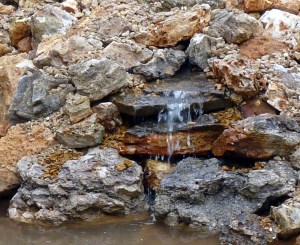
Waterfall structure

I started with two large rocks that probably qualify as small boulders; they were heavy enough that had I picked anything bigger, I would have needed help lifting them. These I settled in place at the base of the waterfall on top of large scraps of liner for extra protection against punctures. I chose rocks a bit smaller than a volleyball next; using these to build up from the base and scattering a few around all the way to the top.
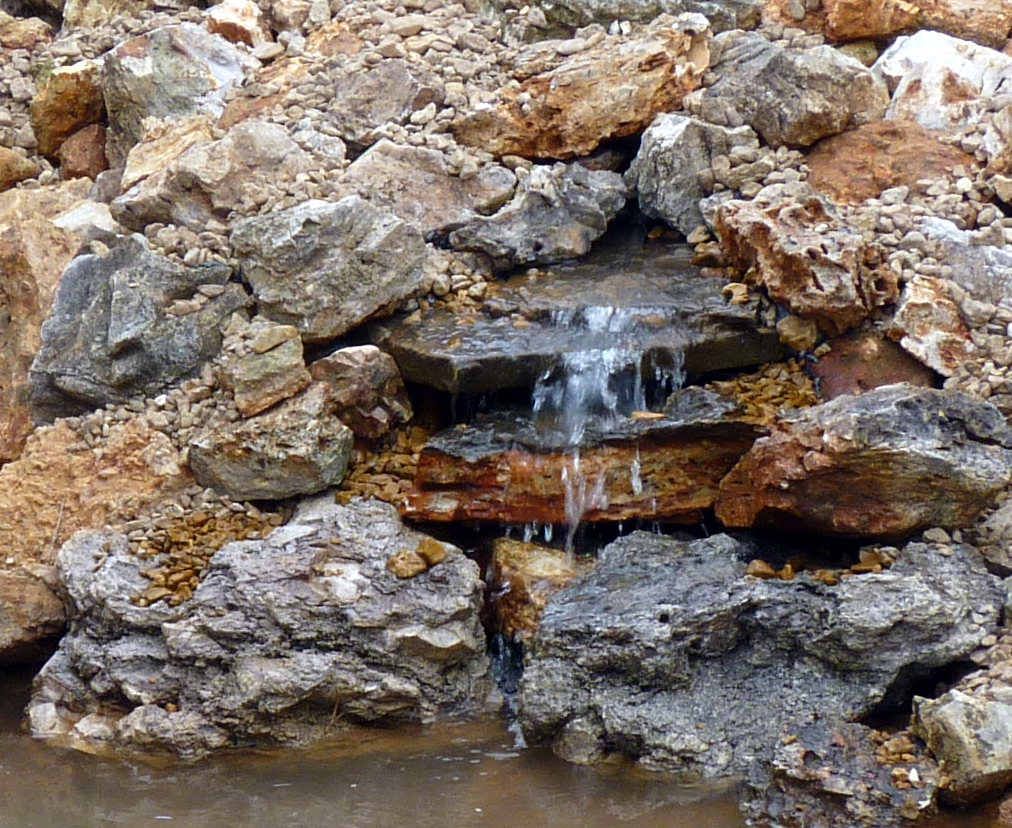
On the top tier of concrete blocks, I placed a single flat stepping stone in the center of the falls. The intention for this rock was to give the water a nice flat place to spill over and into the pond. A couple of large rocks were used at the back of this as an anchor. I also sprayed a little landscaping foam under it when I decided it was exactly where I wanted it and that it wouldn’t be moved.

You can get landscaping foam from the hardware store near the pond stuff. Unlike the house expanding foam, landscape foam is black, doesn’t expand quite as much and is sticky enough to hold small rocks or sand in place until it dries.
Once I had large stones and the basic framework for the falls in place, I ran tubing for my pump. In case you need to move your tubing later for some unforeseen reason (as I did), make sure you run it along the OUTSIDE of your falls and give yourself PLENTY of extra to work with. I went right up the middle with mine and cut off all the excess. I later realized I had only attached a pump for water flow and needed some means of filtering the water to keep it clean and healthy for all those frogs pooping in it. I purchased a UV filter to attach to my pump, only to realize my tubing would not reach the filter because it wasn’t submersible. >.<

This is what giving up looks like.

First I face palmed. Then I sat down and stared at my perfect, beautiful falls that I’d worked so hard on and now had to tear apart to get the old tubing out and run new. Finally, I sucked it up and just fixed it. I swear it doesn’t look quite as good as it did originally and some of the rocks I had stuck in place with foam, so I had to hide the foamy bits by turning these over or putting them in a different spot. I’m just glad I didn’t bury the tubing any deeper, or I probably would have scrapped the entire project in favor of a pondless fountain. So again, run your tubing along the outside of your falls and try not to put it too deep. Also, take care that you don’t place large rocks on top of it; ½ inch pond tubing (which is standard for small ponds) is not as thick walled or sturdy as garden hose, so it squashes and kinks fairly easy.

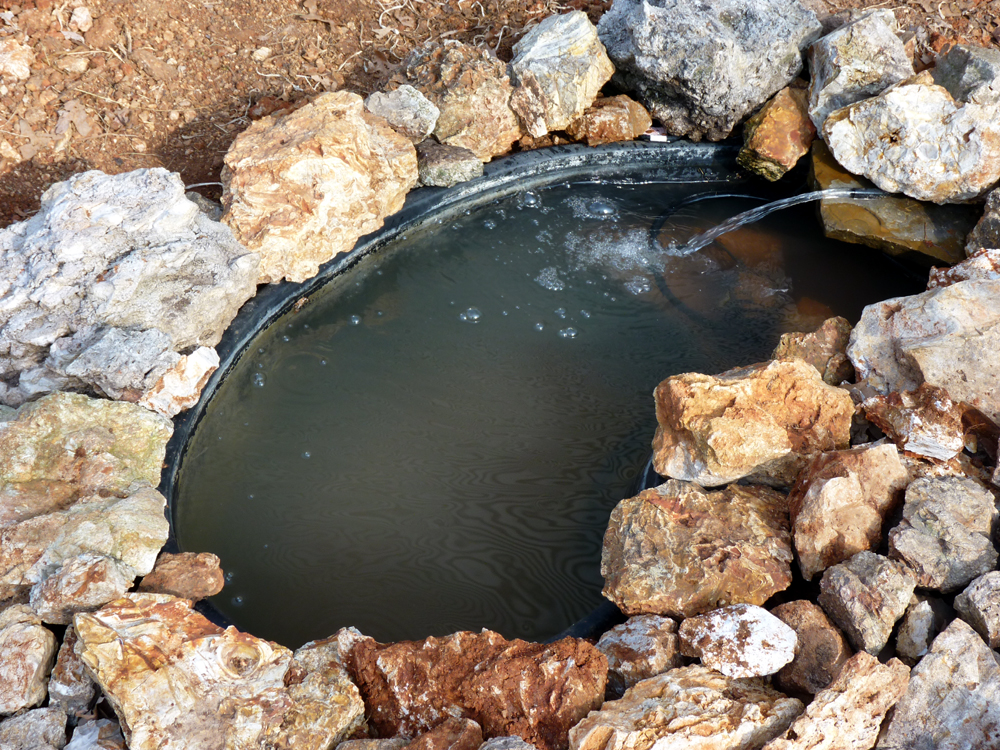
In my new setup, I have a UV filter sitting in the mulch underneath a spirea bush where it is fairly hidden. The submersible pump tubing goes into the UV filter and another piece of tubing comes out the other side of the filter; goes underneath the rock for the falls and opens at the back of that flat paver I put on top of the falls. The water runs over the paver, down several smaller rocks to the large boulders and into the pool.

Whew! Almost sounds like I’m describing a Rube Goldberg machine, doesn’t it? (Except not nearly as interesting)

It’s not a dramatic effect, just enough to give the water some sound and movement. Of course, the larger pump you attach, the more force your water will come out with and the greater the effect of your falls. I had hoped for a bit more flow and may add a larger pump in the future, but for now, this one will do.
I have noticed that the UV filter seems to do a very decent job of keeping my water fairly clean. It’s supposed to take care of bacteria also and there are no charcoal filters to mess with changing. Just switch the light out once a year, according to the instructions on the box. I purchased it from Amazon for $60.

You may need to move some rock around or spray a bit of foam along the watercourse of your falls if you want the water to travel along a specific path or to prevent leakage off the sides. Once you have the filter and falls in place and running, the rest of the setup mostly involves making the pond look pretty and covering any remaining liner.

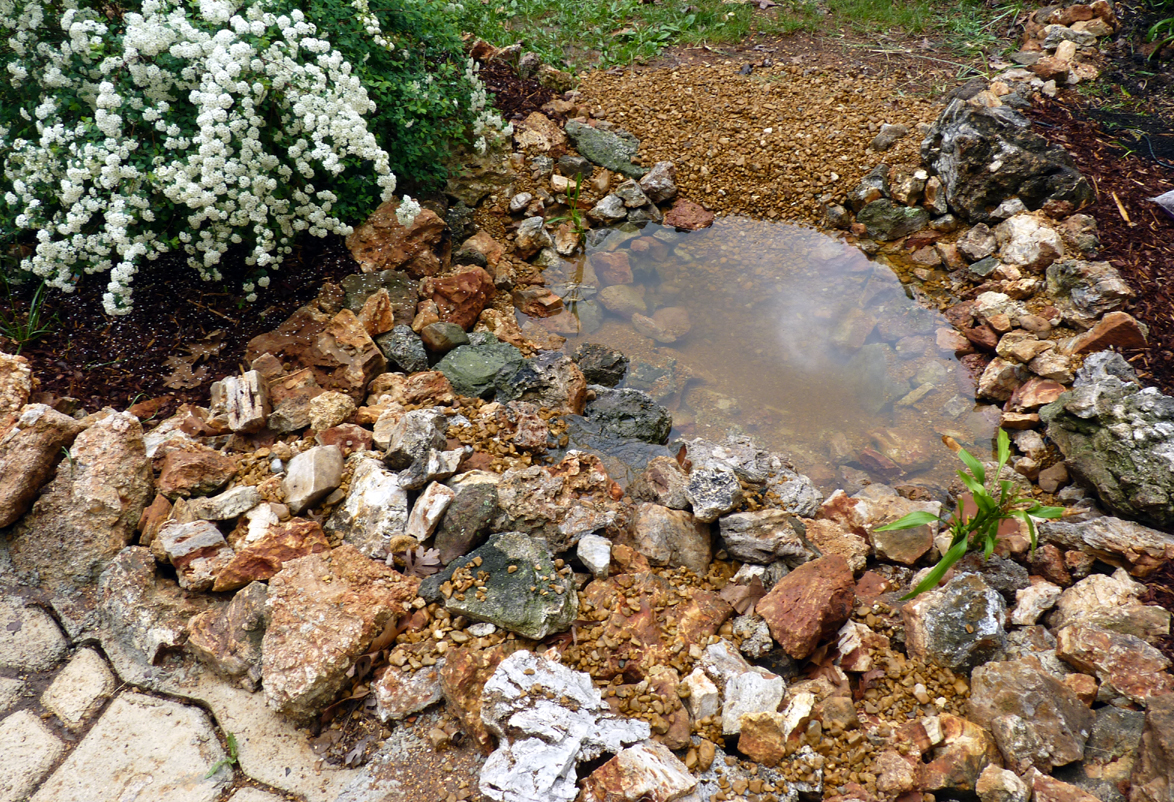
It took me quite a lot of rock to frame in the rest of the falls and go around the pond in a horse-shoe shape. I left the end toward the yard open to make a pebble beach. I had read that if you are trying to attract frogs to your pond, they enjoy a nice beach to get in and out of the water and since my daughter is fascinated with frogs and toads, I built them a beach.
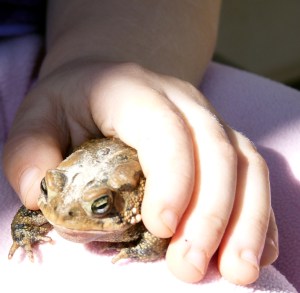
Visitor to our pond

I folded the liner up over the rocks on the garden side, filled that area with dirt and then trimmed the liner off level with the dirt. I covered any remaining edges with a line of

pine mulch. On the side with the spirea, I folded it up over the rocks again, trimmed it and then hid the edge with mulch.

The waterfall area was entirely covered with rock of varying shapes and sizes until very little liner was showing anywhere. Just fit, rearrange and play with it until you get a look you’re happy with. I don’t think there’s any real right or wrong here. Other than physics of course, don’t try and balance big rocks on top of a pile of loose smaller rocks, or you’re asking for a nice avalanche later… which could squish one of those prized frogs. You can use a bit of mortar or more landscaping foam to secure rocks in place once you like the placement if you want to make the whole structure more stable.

For the beach area, I left three of those flat concrete paver blocks underneath the fabric underlayment to give a solid base to the beach, since it’s fairly likely my daughter will be sitting there a lot and it’s also where I climb in and out should I need to get in and work on the pond or move things around. I didn’t trim the liner or the underlayment there, but let it spill out into the yard. I had purchased 3 bags of pea gravel and about 7 bags of river rock to cover this area and finish covering the liner in the bottom of the pond. The gravel stays in place on its own fairly well.

I did see a nice trick for keeping this stuff in place if you do have an issue with it staying put: Put on a pair or those rubber

dishwashing gloves (they are going to be ruined when you’re finished, but at least your hands won’t be), then spray a layer of landscape foam over the pond liner. Over this, press river rock into the foam in handfuls until the liner and the foam is completely covered with rock. When the foam dries, the rock will be glued in place. I did use this trick on the sides of the pond where I had neglected to build a good enough land-shelf for rock to sit on.

After the beach was built, I dumped another couple bags of river rock into the pond to cover the bottom. I hid the pump under a light, flat rock and scattered more river rock around and over it to cover the rest of the pump and tubing from view. A few handfuls scattered over the falls and along the sides of the pond makes it look more like a

natural creek setting and can fill any gaps where the liner still shows.

I haven’t seen any lilies to add to the pond at the store yet. I’ve had them in a pond in our yard in the past and they are wonderful to watch the frogs sit on and gorgeous when they bloom. If I get my hands on any, I’ll be sure to post pictures later. Since there was a lack of water lilies available, I opted to re-pot my bamboo and break a couple pieces off to tuck in to the rocks. Bamboo is ridiculously versatile. It doesn’t really even need soil to grow, it will grow in rocks right in the water. I don’t think this stuff will over winter here in Missouri, but I have two pots worth and don’t mind replacing it every season. If it does overwinter, it may become a problem child later, bamboo can be pretty invasive if not kept in pots where the roots are contained.

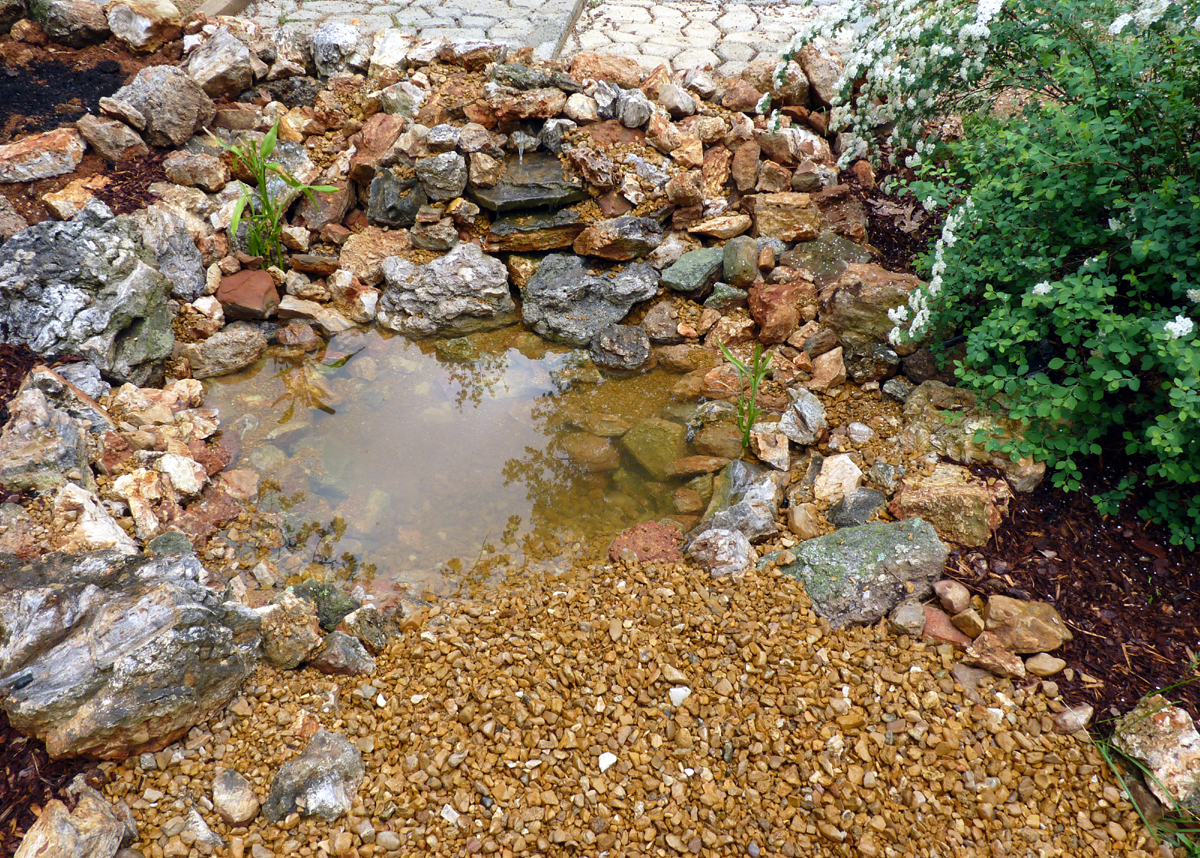
For now this is the finished project.
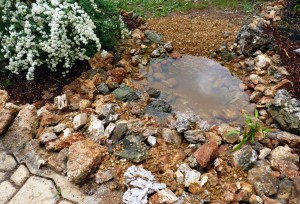
Top down view from the sidewalk

Like every other structure in my yard, I’m sure it will not hold up to scrutiny and will be constantly tinkered with the longer it remains. Perhaps for the next month or so though, I can call it complete and just be content to watch the kiddo enjoy her frogs.  🙂

Finally finished! ….. for now.

-B
Building a Pond, Part 2 Waterproofing

I’m taking today off from the yard. Yesterday I poured concrete for our sidewalk since the weatherman assured me there were going to be several at least semi-dry days in a row. I didn’t want to quit until all the concrete I’d purchased was used and I couldn’t be bothered to stop what I was doing long enough to go inside and put some sunscreen on. Now, I’m sorry to say, I have a very nasty sunburn that is keeping me from the yard. So lemonade from lemons and all that, I thought this would be an excellent opportunity to work on my next post about the pond project.

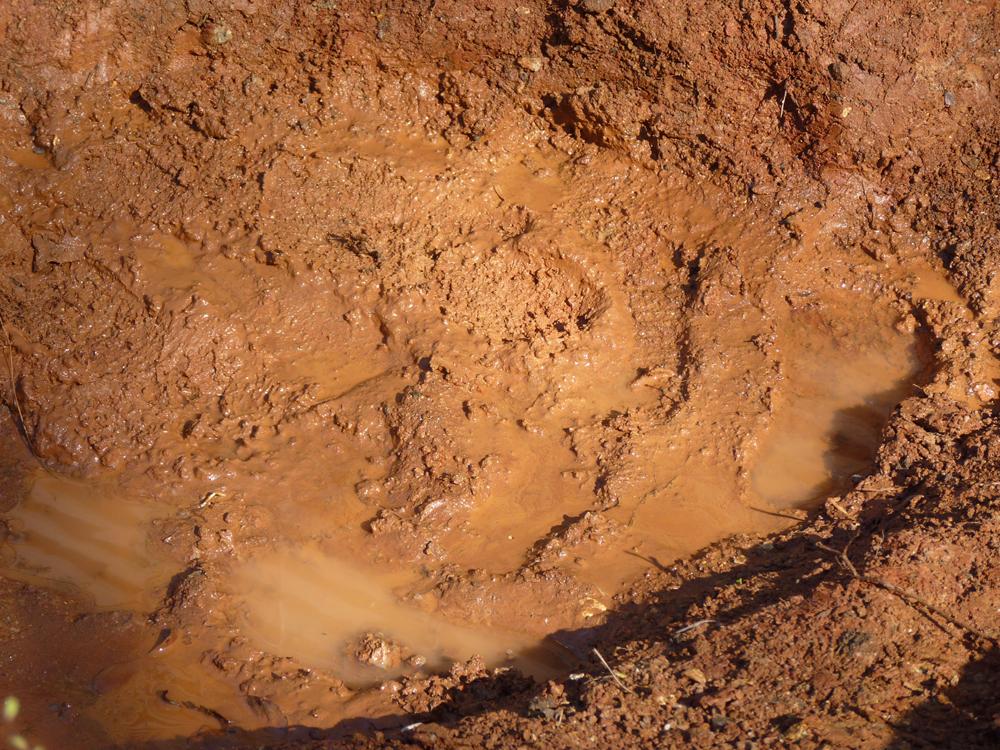
So where were we… oh yes, mud. Lots of mud.

Luckily, I had leveled the edges of the excavation prior to the rain turning the entire pond area into Mudville. I opted for a very simplistic method of accomplishing this: I moved dirt from the higher side of the pond to the lower side until it was mostly level all the way around.
As long as it reaches from one side of the pond to the other, you can use any straight board with a level sitting on top to check level. This works for ponds this size or slightly larger; if you’re doing a much larger pond, leveling will be more technically involved.

Leveling the sides of an organic, freestyle bordered pond is forgiving compared to a formal pond in an exact shape. You still need to level well enough that water doesn’t run out the low side, but minor imperfections can be hidden with rock or plantings.

Perfectly round or square ponds will be noticeably lopsided if the water level is higher on one side than the other. Water will run over the low side and liner will show above the water level on the high side; which makes your pond look silly. Not to mention it can waste a lot of work and expensive materials if you realize that it sucks after the fact and you can’t live with lopsided.

Check for level from every angle, and then check it again before you start moving heavy rocks or mortaring things in place.
Formal ponds may benefit from a brick or concrete block ring set in a light mortar bed around the perimeter of the pond to help it maintain a precise shape and make sure the edge is perfectly level.

Ok, so sides are now level and if you’re me, you’re about ankle deep in mud and not sure whether it feels nice between your toes or just really slimy and gross. It makes a nice SSSSSTHOCK sound when you pull your foot out, which is giggle-inducing to all preschoolers within ear shot. Doubly funny if you lose your sandal to the mud sucking if off your feet. Brownie points if you lose BOTH sandals and nearly get a mud facial trying to rescue them from the bottom of the pond.

I cut my underlayment in half and covered the entire area around the pond and the waterfall, overlapping the underlayment in the middle. An underlayment of some kind under your pond liner is an absolute necessity if you don’t want rocks or sharp roots poking through and destroying all your hard work when you add water.

Water is HEAVY and will cause anything pressing on your liner from underneath to push on it exponentially harder. In the winter, if you leave your pond in place with water in it, this is even more so as the ice pushes up against the walls of the pond as it expands. You need a nice, soft cushion over that hard, unforgiving ground to protect the liner. The clay-type liners are more forgiving in this area, since the clay itself can act as a natural sealant against small punctures. However, a large rip could still destroy even a clay liner, so it’s best to do your prep work regardless of the liner material you choose.
My liner is PVC, because this was cheapest option. EVDM liners are a better choice if you can spend a few extra $; they are stronger (made out of a material similar to car tires) and can tolerate UV rays from the sun better than a PVC liner can.
If you don’t want to fork over the $20 or more for underlayment, a layer of sand and newspaper or cardboard will work instead. Just make sure it’s durable enough that the sharp bits are not going to come through and trash your liner.

After the underlayment is in place, spread your liner out a bit and let the sun warm it up to make it easier to smooth out the wrinkles. A couple of flat rocks on either side of the pond will help hold it in place when you start to add water and can be moved to allow slippage as it fills.

I actually bought two liners for this project, one for the pond and another smaller liner for the waterfall.
The pond liner goes in first, the waterfall liner should overlap it. I had enough for the pond  to run up the waterfall with a bit of slack so that it didn’t stretch too much when I added the large rocks for the waterfall base and then water. Leave plenty of slack at the base of the waterfall liner and let it hang down into the pond. If you’re not doing a waterfall, ignore this entire paragraph. (I probably should have mentioned that BEFORE you read it.)

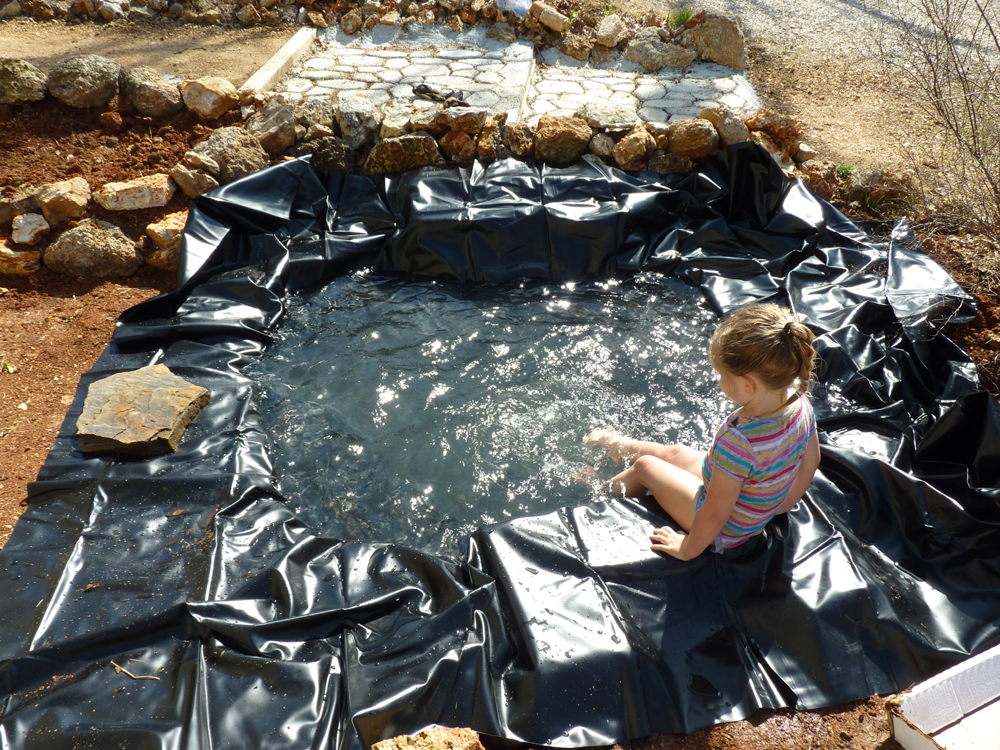
Liners in place, I filled the pond about ¾ of the way with water, adjusting for slippage as it filled. “Adjust for slippage” is fancy landscaper speak for smoothing out the wrinkles enough that it isn’t tight, but doesn’t look the skin on a Shar-pei puppy either.

The spot where my daughter is sitting in the photo has been dug out to slightly below the rest of the sides in order to build a beach area there later. I put some cement blocks underneath for the time being, just to give us a stable place to climb in and out of the pond and keep the water from spilling out of that area.

You can trim off major excess of liner now if you wish, but don’t trim too close to the edge; you’ll want to leave enough to wrap up around the coping stones (your rocks that border the pond) or tuck under the grass if you prefer the natural look. I saved the really large pieces of leftover liner to put under my big stones and small boulders to guard against tears and punctures.

I can’t stress enough how you should buy a MUCH bigger liner than you need for your project. This will ensure that A) You don’t have a nasty “My liner is too freaking small for this hole” surprise and B) That there is plenty to wrap and use for padding.

At this point, the pond is basically in place, but there is still a lot of ugly black liner showing and a PVC covered pyramid for a waterfall. I’m using a basic drop-in pump with an attached UV filter to move the water. If you’re doing a bio-falls and skimmer, you’ll need to watch their little video or call a plumber, etc. to get that thing installed. The drop in pump was cost effective. Previous years, I actually used one of those fish tank waterfalls disguised under rocks to run my small pond. It worked pretty well and was under $30. The drop-in pump in and filter will run you closer to $100, but it can also handle filtering a much larger pond.

Next, it’s time to do a jigsaw puzzle with a big pile of rock…

Building a Pond: Part 1, Hardscape

Our little pond project went better this time, (I hope) only a few hiccups along the way and a little flooding problem I’ll have to be addressing before it is complete. I’m going to be doing this in a series of posts, since it’s a rather lengthy process with lots of pictures. And just a side-note: Water-containing things… still not my favorite element to work with.

Since this was my first attempt at a pond that I didn’t just dig a hole and toss the hard plastic liner in the ground, I did some reading online and even checked out a couple library books on pond construction before I started. I ordered a PVC liner, some underlayment and landscaping foam from Amazon.com. I also hauled buckets and buckets of rock from our woods and surrounding yard to the pond site. I didn’t want to have to buy large amounts of stone; I was hoping to keep the budget for this project under $200.  At this point, I was in $49 for the liner, $20 for underlayment, $50 for a pump and $20 for landscaping foam; so right on target after buying a couple bags of river rock and some mulch to finish it off.

The first two days of this project were all about hardscape. I hauled rocks out of our woods, sometimes by the bucketful or one at a time depending on the size. Some of the really big ones I had to just roll out of the woods, since we don’t have a four-wheeler or other mechanical option to get them to the yard. My daughter helped by picking up smaller rocks and pushing a few of the larger ones back down the hill for me. >.<

I thought that I had more than enough rock when I’d finished, judging by the size of the pile I wound up with. It turned out that this was only about HALF of what I actually needed to do the job, so I spent another day during the pond construction rock searching and hauling. We are lucky cost wise that we have such a huge resource of rock available on our site. If you don’t have this kind of rock readily available, be prepared to shell out a couple hundred dollars to have stones of this size and in this quantity delivered to you.

Third day or so was spent digging. I used an old piece of hose laid on the ground to get a general outline of where I wanted the pond to be. I then stuck my shovel in just deep enough to leave a line in the ground around the hose so I had a rough outline of the pond. Since the back of the waterfall was going to butt right up against our sidewalk, I decided to work on that next. I figured the best way to make it stable would be to build it like a raised flower bed. You lay your first course of rock (in this case, cement pavers I had lying around from a previous project) at least halfway buried in earth. 

The ground slopes from left to right in this area, so I dug a shallow trench deeper on one side than the other to level the first three blocks in. For flower beds, I would usually just eyeball the level. For this project, I went inside and actually got a level and checked each block for level and then all three of the first course for level against each other. I can’t stress how very important it is that this first course be as level as you can get it. For every little bit the first course is off, the blocks you stack on top of it will be exponentially off level which can lead to a very unstable structure. 

I wanted the waterfall to come to the top of the sidewalk, so I stacked blocks 3 high in a pyramid, leaving a few inches for the decorative rock I’d be putting on top. Once I was happy with these later and sure I didn’t want to re-arrange them again, I glued them together with a little landscaping foam.

Now that I had the waterfall base in place, I started digging the pond. This is where I should have done a bit more research, because I made a mistake that is probably going to prove to be a real pain in my butt sometime in the future. I dug out the hole and then went back and built up shelves out of leftover dirt. Our soil is mostly clay, which sticks together and packs nicely, so this was very easy to do.

The CORRECT way to do this is dig a shallow hole for your first layer. Then re-mark the outline of the pond a few inches or so from the perimeter and dig a bit deeper to create a ledge out of undisturbed soil. Then mark a perimeter again a few inches in to create a second ledge of undisturbed soil. Finally, mark your last perimeter and dig even deeper. This is the center and deepest part of the pond where your pump would go.

When you finish it should look like this nice professional picture of the man with his level, which you will note, doesn’t look much at all like the sloppy hole I dug myself. I only put shelves in where I thought plants might sit later. Also, I had this issue with small children in my excavation. If you have a small child in your dig, I recommend you get them out, especially before installation of the rock or liner.
Those first and second layers of shelving in the example pond are not only for plants, but you need them to hold rocks in place that will hide the sides of the liner later. The website I took this picture from is a good example of how to do it right. My dig is an excellent example of what to do if you want to be standing in a pond half full of water later, saying to yourself, “How the hell am I supposed to get these rocks to stay on the sloped sides of this pond?” This was my first major mistake.

The depth of your pond will depend on it’s purpose. If you are only going to put a few water plants in, it only needs to be around 1.5-2ft deep. I kept mine fairly shallow so that my 3-year-old daughter was able to sit on the bottom without the water level being over her head. Had I installed this a year or two ago, I probably would have opted for a pond-less feature with a recirculating fountain.  The current pond is outside the fenced play area of our yard; in other words, it’s in a place where she should never be around it unsupervised. I built our pond with her in mind. It will home to frogs and a few water lilies, but no fish.
If you are building your pond for fish, it will need to be deeper- at least 3 to 4 feet for koi, slightly less for goldfish. Basically, the fish need a place below the frost line where they can hibernate without the whole pond freezing solid. Having fish in your pond may also involve installation of a heater and a pump to keep oxygen circulation going.

I didn’t finish the pond the day I dug my hole. I ran out of steam and time, so I let it set and planned to pick up where I’d left off the next day. Then it rained. A lot.  And I wound up with a big, muddy hole, ¾ full of water. Did I mention that clay is an excellent medium for holding water? In fact, they make natural pond liners out of clay and a bonding material that you can use to line your pond if you prefer not to use PVC or EPDM liners. It’s more expensive, but can be self-sealing and it’s a natural alternative to plastic or rubber. Large scale farm ponds around here often utilize clay as a pond base to hold the water in.
SO… after it finally quit raining, I went out and pumped and bucket-scooped the water out of the hole so that I could replace the muddy, mucky mess with my nice, clean PVC liner. The fact that the pond held water so well without any liner at all should have told me this would be a problem later. I was oblivious however and continued on, unhindered by mud or knowledge of hydrostatic pressure and ground water tables.
…to be continued…

In Spite of a Certain Groundhog, Spring is Here. :)

I’ve threatened to shoot myself a groundhog several winters when the snow, ice and cold have just lazed around into April or so. This year, I can forgive that silly hog’s predictions, since he’s obviously become senile and doesn’t have the weather channel in his burrow. In spite of Phil’s predicted long winter, spring seems to be early this year. Maybe not in your part of the country, but here in Missouri we have things blooming  and pollen counts shooting off the charts already.

I’ve been bit by the spring bug in a big way, planning flower beds, working on our pond, getting our seeds ready to go in the garden next month. By the way, if you plant cold weather crops, like broccoli, lettuces or beans, they should go out NOW in our region. Wait much longer and it will be too warm. We’re starting simple this year with a few peppers, some strawberries and a couple different tomato plants, so it will be next month before our little seedlings head outside. If you haven’t started your seedlings yet, get them started as soon as possible!

I have a big post coming up on our pond re-do, but it isn’t finished yet (I’m still waiting on parts to ship) so I thought in the meantime, I’d take a couple pictures of the blooming stuff in our yard. My roses are covered in tiny new leaves, I have daffodils coming up and the crocus have already made an appearance. The tiger lilies are taking off like crazy, I’ve been separating them and moving them about the yard again, they tend to stop blooming if they get too thick.

I have seen bag worms already on a couple of the trees, so watch out for those nasty little buggers on your ornamentals; they can do some serious damage once they leave the nest. I don’t like to use poisons any more that absolutely necessary so I just burn them out with a lighter. They smell like burnt hair which is gross, but the damage to the tree or shrub is minimal, doesn’t involve a bunch of nasty chemicals being sprayed all over the place and is pretty damned effective at destroying the entire nest.

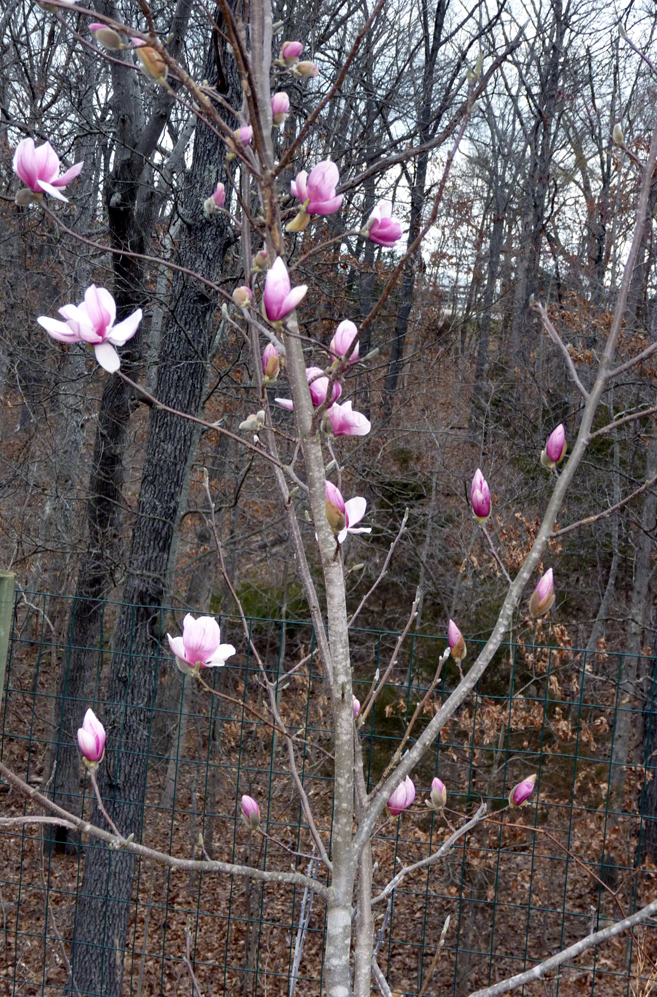
Our magnolia tree put out quite a show of blooms this year and the smaller one I transplanted last year even favored us with a single flower. They don’t like to be moved and I think I really annoyed it by doing just that. I’m hoping the bloom is a good sign that it’s recovering. Our fire bush is also covered in blooms. I’m not sure what the scientific name for it is, that’s what my family always called them.

The official Spring Equinox isn’t until March 20th. However, Meteorological Spring (which I just heard this term this morning) apparently started March 1st.
Off to take some Tylenol for all the shoveling I did today.
-B
Fail Pond

I may be a belle of dirt, but when it comes to water features I fear I’m more like a sad, ugly duckling.

After several days of working on our pond, I’ve decided that I absolutely hate it. I can’t get it to look natural, no matter how much rock I add  or which way I position them. I was also disappointed that I wasn’t going to get my waterfall with this configuration. So… after 3 days of moving rock and digging dirt and filling this thing with water, I’ve decided to scrap it and start over. It’s only the first of March, so I have time- right?
I keep thinking of all the other little projects that need my attention before we have plants ready for our veggie garden this year. Trellises to build, beds to prep, the lawn needs a dose of fertilizer and crab grass prevention, leaves to rake, clean up the pool area and build my daughter a sandbox- the list keeps growing and growing, faster than most of my plants.

But this pond has been sort of my nemesis in the past and apparently is rearing it’s ugliness again. My main gripe with it is that no matter how I dress it up; with rocks, with plants, carefully mounding dirt or sand all the way up to the edge, it always looks to me like someone dropped a plastic cattle trough in the ground. It looks manufactured and contrived and nothing like the tranquil- I- just- appeared- here- in- the- yard- of -my- own -volition- look that I really want. This year I added a ton more rock, I even found a nice flat rock to run the fountain over instead of having a black plastic fountain spraying in the air. My husband commented that this was a nice effect and he notices next to nothing in our yard. Still not happy with it.

I look at those black plastic edges mocking me and all I can see is FAIL FAIL FAIL.

After a very grumpy inspection of it yesterday, I went in to my computer, logged on to Amazon’s site and ordered stuff to build a new pond. I have a plan  in my head and 10 or so flat concrete blocks which I hope to build the waterfall out of. I’m going to have more digging to do, and some ground leveling behind where I want the pond to sit so the waterfall has a level base. I ordered an underlayment (protects the rubber liner from rocks, which our yard has in abundance), 2 rubber liners (one for the waterfall and one for the pond), some landscape friendly expand-a-foam (supposed to help direct the water and hold rocks in place) and more 1/2 inch tubing. I already picked up a pump last week. As soon as all this gets here, I’ll be starting over. . I may need to go pick up some mortar to keep the waterfall rocks in place- but only after I’ve lived with it for a few weeks and decided I’m happy and don’t want to change it again.

I’ll post pictures of the new version and it’s progress. Wish me luck!

-Belle


I’m SO gonna feel that tomorrow

My 3 year old daughter has been my little garden helper the past couple days. She’s at that age now where she’s able to learn that there is an actual purpose to playing in dirt, besides the obvious perk of getting dirty or eating it.
We decided that this year we were going to grow some veggies. I didn’t want to spend a lot of $, I’ve had good success with tomatoes in the past and a cucumbers, but I’m fairly sure it’s a near impossibility to screw up either of those. This year we are getting a bit more ambitious.
We browsed the seed catalogs and ordered 8 packets of veggies and a couple of flowers we liked. The seeds we chose were 1) Roma tomato 2) cherry tomato 3) sweet red pepper 4) sweet heirloom yellow onion 5) sweet yellow pepper 6) sweet orange bell pepper and 7) mini cucumber. We also got packets of echinacea (purple coneflower), sunflowers and a marigold mix. I picked the marigolds in particular, because they are a natural insect deterrent and I’m hoping they’ll keep my need to spray or dust to a minimum (if at all). I’m a big fan of natural insect control and fertilizer, I hate dumping poisons around or on the stuff we plan to eat. We’re also putting a pond right in the middle of the garden bed. This will encourage the many frogs we have nearby to hang out and munch on the insects invading our veggie patch.
I’m building trellis straight up the side of the house out of just simple wire to support the vines. Nothing fancy and very inexpensive. I’m hoping the vines will pull double duty and absorb some of the heat that would otherwise be beating down on that southern exposure of the house. Due to our satellite TV and wireless internet, I can’t plant a tree there to block the afternoon sun. The veggies are going right into an old flower bed that was formerly full of nothing but tiger lily and butterfly bush. I had put off for years doing a vegetable garden, thinking I needed a formal space. They’re plants. They can grow in any garden bed and they don’t mind if they’re next to flowers. Silly me.
Some seeds need to be started indoors several weeks before the last frost and then transplanted outside. We’ve been saving gallon milk and water jugs for the past couple months to use as mini-greenhouses. I’m hoping they work well. They should help keep the seedlings warm, give them filtered light and help trap moisture in the jugs so the soil doesn’t completely dry out. I cut the tops nearly all the way around, leaving the two halves attached at the handle. My daughter helped me fill the bottoms with soil, then we sprinkled on our seeds, added another light layer of dirt and misted this really well with water. We’ll be checking them each day and misting with more water as needed. The jugs are also easy to write on, so you can identify what’s what when you’re ready to transplant the seedlings. I’ve saved egg cartons for when we get to that stage.
The bed outside is just a raised bed, filled partially with native soil, outlined with rocks I’ve picked up around the yard and in the woods. I’ve added some potting soil and quite a lot of compost as well, our native soil here is mostly rocks and clay. Clay has decent nutrient content, but not great drainage and isn’t always the best medium for young, tender roots.
We’ll post more pictures and updates of our trials or success as the project moves along.  I haven’t done this kind of digging or planting for a couple years now, going to be feeling this tomorrow! 🙂

Aahhh… AaaaH-ChOO! Quick! Get me a Potted Palm!

Winter is on its way.  I’m already planning our Christmas light display for this year and deciding where we’ll put the tree.  Decorations of red and green aren’t the first sign of dropping temperatures around here though; for us it’s the instantaneous jungle that happens in the living room overnight as soon as I hear the dreaded words “Frost warning advisory” on the evening news.
I confess; I’m a rescuer. I can’t walk by a poor, sad looking, 30%-off plant for sale in the store and NOT bring it home to nurture it back to life. This is how I gradually acquired the small forest that is parked behind our couch each winter; one sad little orphan at a time, I brought them home to nurse them back to health and watched most of them flourish under a bit of attention. We haven’t had curtains over our bay window since we moved in. There’s no need for window treatments with a miniature Amazon forest completely filling the view.  My husband has been good natured (pardon the pun) about my obsession so far, but has admitted to having Jumanji fears about some of my more aggressive growers.
In defense of my frond habit, houseplants are good for you. It gives seasonal gardeners a little something to do during the deep winter months, other than planning beds spring and browsing seed catalogs.  A much quoted NASA study claims that houseplants reduce indoor air pollution and improve air quality. (They wanted to know their effect on air quality on board space stations) Scientific American claims “Houseplants make you smarter! Research suggests that the mere presence of plants can boost attention span.” Ask any good home stager; houseplants are a quick and economical way to brighten, add color and life into an otherwise dull room. Plants are said to reduce stress, increase room humidity in dry climes and fight fatigue.  
Anyone that has been zapped by a sibling intentionally dragging their feet across the carpet in January and then touching your innocent, unsuspecting earlobe to watch the spark and hear you yelp should understand the value of having houseplants.  It may sound contradictory to have a houseful of plants and dirt in an allergy sufferer’s home, but if your allergies are to dust mites and mold, plants can help.
Dry winter air can set off asthma and allergy attacks faster than a field full of ragweed. My allergist once told me a rather disgusting fact as to why this is the case: Dust mites live in your carpet and on other cloth surfaces in your home- like curtains, furniture, throw pillows, rugs, etc. Molds can grow in your ventilation during the summer with the cool, humid air provided by your air conditioner. When you turn on the dry winter heat, the mold dries out too and the fine particles are blown right out of you vents and into the air of your home. Dust mites die and their bodies fall into the carpet padding and furniture. When there is sufficient humidity, most of the dried out little exoskeletons stay where they drop until you vacuum them up.  In winter, they are more likely to become airborne, since every time you sit or walk on the carpet, you dislodge some of the dried out bits into the air. Plants are nature’s natural humidifiers; ergo they help keep nasty dust mite bodies from floating out of your carpet and up your nose. Plants act as a natural filter to those pollutants that do become airborne.
The more draft-proof and energy efficient your home is the better chance of trapping pollutants inside. In addition to inhaling dust mite parts and molds, you may be breathing a chemical combo of gases released from the building materials, carpet, furniture finishes and fabrics in your home. Houseplants not only convert carbon dioxide to oxygen- they’ve been found to remove elements like formaldehyde, benzene and trichloroethylene from the air. 
Of the plants tested in the NASA article, the following are the top best for filtering toxins and improving air quality. (Of which I have several, I’m pleased to add)

  1. Philodendron scandens `oxycardium’, heartleaf philodendron
  2. Philodendron domesticum, elephant ear philodendron
  3. Dracaena fragrans `Massangeana’, cornstalk dracaena
  4. Hedera helix, English ivy
  5. Chlorophytum comosum, spider plant
  6. Dracaena deremensis `Janet Craig’, Janet Craig dracaena
  7. Dracaena deremensis `Warneckii’, Warneck dracaena
  8. Ficus benjamina, weeping fig
  9. Epipiremnum aureum, golden pothos
  10. Spathiphyllum `Mauna Loa’, peace lily
  11. Philodendron selloum, selloum philodendron
  12. Aglaonema modestum, Chinese evergreen
  13. Chamaedorea sefritzii, bamboo or reed palm
  14. Sansevieria trifasciata, snake plant
  15. Dracaena marginata , red-edged dracaena

Most of these are fairly easy to grow, even for a novice. Philodendron and spider plants are virtually indestructible. Almost all will grow under fairly low light or much filtered light conditions, which means you can place them around the room in you home- not just crowded in front of windows. They are considerably cheaper and more fun to look at than a commercial air purifier.
If you have small children in house, be sure to teach them never to eat houseplants and not to crush the stems or leaves. Some, like the leaves of English Ivy can be skin irritants are also poisonous if eaten. For a good comprehensive list of poisonous house plants, check out http://www.guide-to-houseplants.com/poisonous-house-plants.html. Contrary to popular belief, poinsettias are not one of them, but the sap can be irritating if you get it on your skin.
My daughter was more partial to eating the dirt out of our houseplants than the plants themselves. I actually tried it once to see what the attraction was; I’m not much of a gourmand, but it’s not high on my list of recommended cuisine.

Doggie Septic System

Spring is here and I’m back in the dirt!

I took a little break from posting while I was doing next to nothing around the yard. Raking leaves and mowing don’t make for especially interesting post material and I did little else towards the end of the 2010 season.

This winter I spent planning. I have grand designs in my head for the side yard this year; the only area of our yard that consistently gets full sun year round. There will be a large raised bed for plants and flowers, space for some edibles, trellis along the wall for some vertical interest, a small pond and sitting area… whew. I’m worn out already and haven’t even put a shovel in the dirt yet.Puppy Poo

My first project for 2011 was a small one, but addressed a big problem. Last week we adopted a new puppy. She’s a German Shepherd-Bull Mastiff mix, so will be a rather large dog in a very short time. Large or small, I discovered that 5 week old puppies need to relieve themselves a great deal. The area of the yard she was using for her potty area was already a mine field of puppy bombs; impossible to navigate safely when dragging her out to do her business at 3am, stumbling around in a bathrobe and sandals, half asleep. Worse yet, my 2-year old has a tendency to gravitate towards this area whenever she is out playing in the yard.

I’d seen an episode of Gardening By the Yard on HGTV where Paul James creates a simple doggy septic system from a 5 gallon paint bucket. (Unfortunately, the show is no longer on the air and I couldn’t find the episode on HGTV’s website, but I remembered enough to make it work.)

First you need a 5-gallon bucket or larger container, with a lid. If you have small children like I do, a snap on lid that fits tightly will probably be your best bet. Lowes had empty 5 gallon buckets for under $5.00 and the lids were under $2.00. You’ll also need a small bag of gravel or some small rocks collected from your yard and a bottle/can/jar of bacterial or enzyme septic system treatment.

Here’s how to set it up:

In a corner of the yard that’s convenient, (I chose the area where our puppy already tends to go) dig a hole deep enough to bury your container with only a couple inches sticking up above ground. You’ll want to leave it sticking up like this just a bit to keep water run off from flooding it, it also makes it easier to get the lid on and off if it’s not completely buried.

After I’d dug my hole, I turned my bucket over and cut the entire bottom out of it with a jigsaw. If you don’t have the tools to cut out the entire bottom, you could just make the bottom half look like Swiss cheese with a large knife. Enzyme septic treatmentThe point is to allow plenty of drainage so that the contents of the bucket are eventually absorbed into the surrounding soil, not just filling up the bucket over time.

I put my bottomless bucket in the hole and poured in small gravel to 3-4 inches in the bottom; enough to hold the bucket firmly in the hole and allow for plenty of drainage. Move the bucket around until it settles level or at least close to level in the hole and then back fill with dirt around it. Don’t forget to leave an inch or two sticking up from the surrounding soil. I used my remaining dirt to fill a low spot in another part of our yard.

Pick up your dog’s waste and drop it in the bucket. Sprinkle a bit of your septic enzymes over the top of this and maybe throw in just a handful of dry leaves if you have some lying around. Add a cupful of water to the mix and snap on your lid. The enzymes will break down the waste over time, just as it does in a home septic system. It’s contained, there’s no smell and you don’t have to walk through your yard as if you were navigating a minefield.

Visiting friends, small children and your local Fed-Ex delivery person will thank you as well.

Ely’s Playhouse

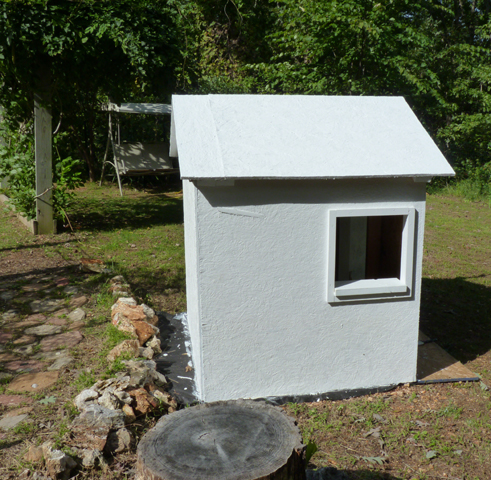
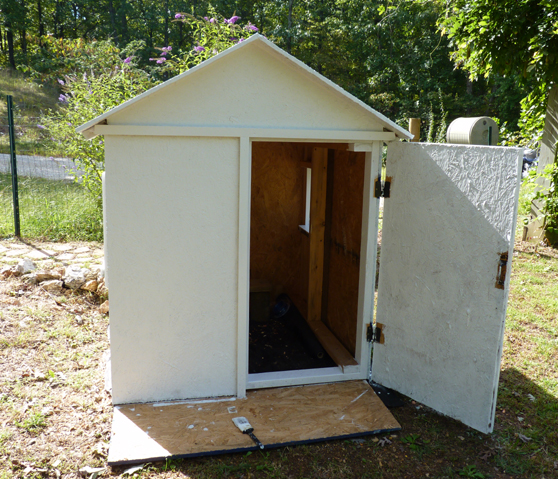
As I write this, the first coats of paint are drying on my daughter’s new playhouse.
Right now it is just plain white, I’m trying to decide whether to paint it a color and if so, which color might look best on it. Her bedroom is a soft gray with bright pink and ombre pink/white curtains, one wall is painted with silver glitter floated in acrylic. Although our house is an ugly shade of taupe that I would love to paint, I’m thinking the same soft gray I used in her bedroom might look good on her house as well, perhaps with pink trim on the windows and doors and a lighter shade of gray on the roof, as her bedroom ceiling is.  I bought small sample paint cans at Lowes, (7.6 oz size samples are available in almost any color and are very cheap!), these I intend to mix with white to paint flowers on the roof before I’m completely finished and cover them with a layer of acrylic to protect from weather.

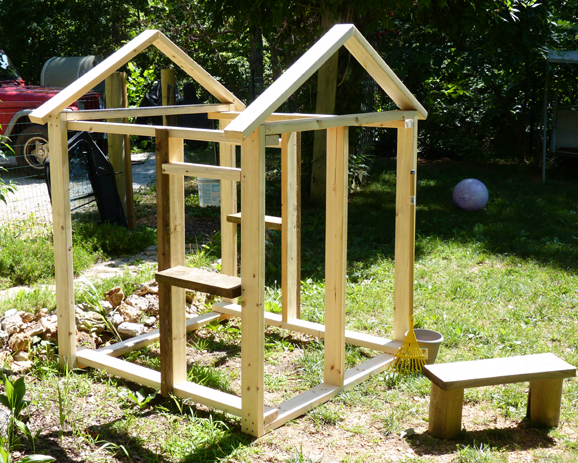
Playhouse Frame

Playhouse Frame

We had framing lumber in storage that we’d bought for another project. If we’d had to buy this for the house, it would have been about $30.00.  Here’s what we used to build the house:

10 2×4’s (framing lumber)
2 leftover bits of 2×6 for sills

leftover bit of 2×8 for bench seat
leftover bits of post from fencing for bench  (these were the round posts I used on the yard fence in the spring)
4 4X8 Sheets of OSB (plywood pressboard)
5 1×2’s for trim around windows, doors  (this stuff is cheap, but looks fine painted. About $1.30 each. Much cheaper than what’s marked “trim” at the hardware store)

white severe weather outdoor paint

2 large hinges for the door

cabinet handle to open and close the door

sample paint in primary colors: bright red, deep blue and bright yellow. I can mix these with white or black to get many other shades

Front of playhouse

Front door of playhouse

My friend brought me some old artist’s brushes  to do the flower drawing on the roof. If you don’t have access to these, you could use kids watercolor brushes or even makeup brushes, available at almost any department store.

heavy landscaping fabric

bag of cedar dog bedding

The house is about 4 ft by 4 ft. My husband and I cut out the frame and nailed it together, framing in extra for the windows, door and roof supports.

We covered the frame in thick pieces of OSB. This is pressboard, which is not as pretty as finished plywood, but it is MUCH cheaper. It has a rough raw side and a smoother, more finished side. We kept the rough side facing out, since this would be painted over later. The smooth inside leaves less chance of splinters in little hands.

We notched in leftover bits of 2×6 to make wide windowsills, these I may add flower boxes to later when our daughter is a bit older (she’s only 2 now and not ready to plant flowers just yet). Another piece of leftover 2×8 and part of the posts we used to fence the yard made a perfect child-sized bench seat.

Playhouse side view

Side view of playhouse

Underneath the house I spread a thick layer of cedar chips, you can get this in large bags meant for outdoor animal bedding. Cedar chips are better than hardwood mulch for this purpose since they repel insects rather than attracting them, plus they smell nice too! Over the cedar chips, I put down a layer or landscaping fabric, which keeps weeds away from the edges of the house, covers the cedar chips to keep them from getting scattered and makes a sort of carpet to play on inside the house. I’d like to find a square of boat or outdoor carpet to put over this eventually, just to keep the landscaping fabric from getting torn during play. Our yard is mostly rocks/clay, so the cheap pins that came with the landscaping fabric didn’t work so well, I could only get them part way in before they’d start to bend and warp. I wound up using the house itself to anchor the fabric and just cutting it around the edges.

We added a leftover piece of OSB under the door as a sort of  porch, it helped to hide the edges of the landscape fabric in front. The sides and back I will finish off with rock to match the sidewalk when I finish painting.

I used outdoor window caulk to fill the crack along the roof line, around the eaves of the roof and along all the seams inside the house. This made it fairly weatherproof and though the windows are uncovered, the inside stays relatively dry, even in heavy rain. I let the caulking cure completely before painting over it. The instructions on the tube should give you the curing time; it may vary depending on humidity, temperature, etc.

Front of playhouse

Ely's Playhouse!

I used a brush for the trim work, edges and door and an all purpose roller for the large, flat areas on the walls, door and roof. I’ll probably have at least 4 coats of paint on when it’s finished. This will smooth out the rough texture of the OSB and hopefully protect the house from weather wear. I’m debating on whether or not to paint the inside to make it look more finished. This will probably depend on time and funds, it’s certainly not necessary since I heavily caulked the cracks to protect it from weather damage; it would be a purely aesthetic choice. This is what the house looks like so far. I’ll post new photos once I decide on color, roof design and finish the landscaping.

I’m SO glad to be back to work on projects again! My hand is still a little sore from surgery, but MUCH improved.

12 Step Program for Dead Tree Removal (belle style)

(Original article from ExistentialBelle.com Jan/2006)
My husband insisted that I re-post this article that I wrote for my personal website in 2006; he says it was always one of his favorites.

Step 1) Cut down big f*$#-off tree right behind your house. Make sure you get someone equally brave/ignorant to help you, so that you can do the pushing while they cut through the trunk. (Otherwise you’ll have a tree on your house, which is rarely a good thing)

Step 2) Watch your helper rip the blade off the chainsaw as the tree shifts and starts to fall. Point and laugh.

Step 3) Yell “TIMBER!” at the top of you lungs. This will convince your neighbors that you are insane and make their dogs bark.

Step 4) Jump out of the way in time to avoid getting creamed by the trunk when the tree falls and it kicks back.

Step 5) Realize that since the chainsaw is now broken, there is no way to finish the job you’ve started. Leave the tree lie in the yard for at least one year to dry out and get brittle. This is VERY important to the next steps.

Step 6) Not less than a year later, go and gather all the small broken branches from the tree and put them in a pile.

Step 7) Break a few more branches off, this is easy since the tree is now brittle. If you didn’t follow my advice in Step 5, then go back inside and complete it before moving on to the next steps.

Step 8 ) Since the chainsaw is STILL broken a year or more later; get a flimsy hacksaw and attempt to saw through some of the remaining branches. If you get tired, come back at random intervals over a course of months.

Step 9) When you have successfully removed AT LEAST one branch with the hacksaw; decide this is too much work and use your body weight as leverage to snap a few more medium to large sized branches off. Again, if you didn’t follow Step 5, this is going to be MUCH more difficult.

Step 10) Be sure to fall on your ass at least a couple of times when the branches break off. It’s especially helpful if the branch lands on top of you, pinning you to the ground for a few minutes. Sitting on a thorn bush gains you extra points.

Step 11) Pile all your torn branches up. Collect enough trash in the house to set them on fire. Pizza boxes and 12-pack cases are excellent for this. Toilet paper rolls and old bills burn too quickly to start a decent fire.

Step 12) Here’s where you must make a decision about what to do with the remaining branches you couldn’t break off, plus the tree’s trunk (which you’re NEVER cutting through with that hacksaw, a year old or not):

-If the tree doesn’t bother you much and you’re not all that ambitious, leave it where it is. It will get more brittle each year it lies there; eventually you will be able to remove more branches and possibly the upper part of the trunk in time. You can use the trunk as a little bridge to get to other parts of your yard; at least until the termites do enough damage that your foot goes through when you step on it.

-If the tree is REALLY an annoyance and you’re a bit more ambitious, you can try raking leaves and piling yard waste, trash, etc on top of it and slowly burning it until it’s gone.

-If you aren’t even ambitious enough to burn trash on it, then bribe a friend with a chainsaw to come cut it up for you in to nice, manageable chunks. Or, if you have money to just throw away, you can always call a professional yard/tree service to remove it for you.

So there you go! Tree removed, problem solved!
Plus, as an added bonus, unless you called the tree removal service, you can brag to your friends that you did it ALL BY YOURSELF!